
A company's size gives a first indication of some features of the investment, in particular its liquidity, meaning how easy it is to buy or sell its shares, and its volatility, meaning how much its share price moves. It does not, however, guarantee its solidity or its future performance. Here is what you really need to understand before relying on this one criterion.
What is market capitalisation?
Market capitalisation is the current price of a share multiplied by the total number of shares in circulation. It is used as a benchmark to compare the size of listed companies.
Take a fictional company whose share is worth CHF 50 and which has 40 million shares: its market capitalisation comes to CHF 2 billion. If the share price rises to CHF 60, it climbs to CHF 2.4 billion, without the company having changed in real size.
A distinction is therefore made between large caps, often seen as more stable investments, and small caps, which can offer higher growth potential in exchange for more pronounced volatility.
These two categories play a different role in building a portfolio. Understanding what sets them apart helps an investor spot the opportunities available, while keeping a clear view of the risks attached to each.
What are the main size brackets?
There are no universal thresholds for classifying companies. The amounts below are indicative benchmarks, published by FINRA, the US regulator of brokerage firms, and expressed in dollars. They can vary depending on the market and the method used.
- Mega cap: USD 200 billion or more
- Large cap: USD 10 to 200 billion
- Mid cap: USD 2 to 10 billion
- Small cap: USD 250 million to 2 billion
- Micro cap: less than USD 250 million
These categories remain relative, not fixed.
In Switzerland, the indices of SIX, the Swiss stock exchange, provide another reference point: the SMI brings together the largest companies, the SMIM the next 30, and the SPI Extra all SPI companies outside the SMI, in other words the small and mid caps.
Large caps
Large caps are listed companies whose stock market value exceeds USD 10 billion. In Switzerland, groups such as Nestlé, Roche or Novartis are among them.
Among large caps, some are known as "blue chips" because of their size, their reputation and the high liquidity of their shares. Swiss blue chips are the names found at the top of the SMI, the Swiss stock exchange's flagship index. Their equivalents appear in the CAC 40 for France or the EURO STOXX 50 for Europe.
But a large cap is not immune to every risk. The story of Wirecard is a reminder: added to the DAX in 2018 and once presented as one of the jewels of European fintech, the company collapsed in 2020 following a major accounting scandal. In June of that year, it applied to open insolvency proceedings, a few days after admitting that EUR 1.9 billion recorded in its accounts probably did not exist.
The lesson is simple: a company's size never guarantees the quality of an investment. Doing your own research remains essential, including when you look at smaller companies, which can also have their place in a diversified portfolio.
Small caps
As the name suggests, small caps have a much more modest stock market value, generally between USD 250 million and 2 billion.
They can be found in every sector and at every stage of development, including in Switzerland, where many of them are in the SPI Extra, alongside mid caps.
Contrary to a common belief, small caps are not always young start-ups. Many are, on the contrary, well-established companies, with a solid track record and a sound financial position. It is precisely their smaller size that gives them, in theory, more room to grow.
What are the features of large caps?
Beyond their size, large caps are generally long-standing, well-established companies. They are often market leaders, with brands that are widely recognised by the general public.
Because they are often more mature and sometimes have more established revenues, some large caps pay regular dividends. This is, however, neither systematic nor guaranteed.
What are the risks of small caps?
Small caps can offer attractive growth prospects. They also carry specific risks, especially when it comes to volatility and liquidity.What are the risks of small caps?
First, their volatility is generally higher: price movements, up or down, can be sharper than for larger stocks. A lower trading volume is often enough to move their share price significantly, sometimes even within a single trading day.
Next, these shares are often less liquid and less traded, with wider gaps between buying and selling prices, which can make opening or closing a position more expensive. It is the kind of nuance that is better known before investing than after a first bad surprise.
What place do small caps have in Switzerland?
In Switzerland, a few very large companies dominate the stock exchange. Knowing how much small caps really weigh helps you understand what an investment in Swiss shares actually contains.
A market driven by a few giants
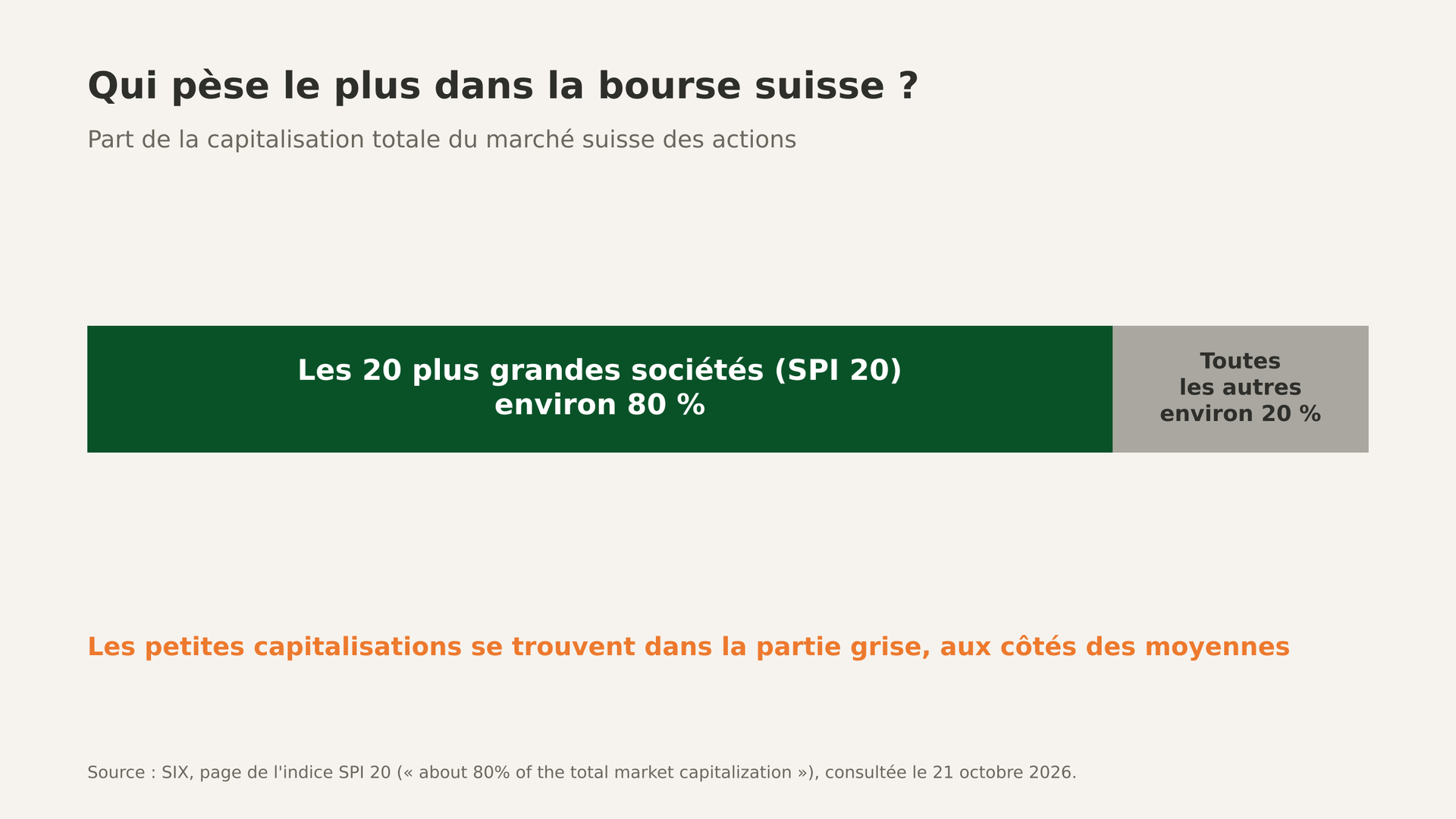
According to SIX, the 20 largest listed companies, grouped in the SPI 20, account for about 80% of the total capitalisation of the Swiss market. The SPI, which covers more than 200 companies, is therefore largely driven by a handful of big names. In practice, a fund that tracks the SPI invests mainly in large caps. Smaller companies are included, but their weight remains low.
Using a fund rather than a single share
For a private investor, picking a small company yourself takes time and knowledge, and the risk of getting it wrong is high. A fund that invests in many small and mid-sized companies spreads this risk across dozens of shares.
It does not remove volatility, but it avoids betting everything on a single company. In all cases, the share you give to small caps depends on your investment horizon and your tolerance for price swings.
Conclusion
The key point about small caps vs large caps fits in one sentence: market capitalisation gives useful information about a company's size and some features of its shares, but it is not enough to judge the quality of an investment.
Large caps often offer more liquidity, small caps higher growth potential, at the cost of more pronounced volatility.
To take a first step today, try this exercise:
- Choose three Swiss companies you know.
- Find their market capitalisation on your bank's website or a financial platform.
- Check whether they are in the SMI or the SPI Extra.
You will quickly see that size does not tell the whole story, and that is already a good investor's reflex.
To get started: the Academy's Foundations programme, free, helps you lay the groundwork before going further with investing.
To get started: the Academy's Foundations programme, free, helps you lay the groundwork before going further with investing.
FAQ
Is a small cap necessarily a young company?
No. Many small caps are well-established companies, with several years or even decades of history. Their modest size is mainly due to their sector or their growth strategy, not necessarily their age. To judge them, their business model and financial health matter far more than how old they are.
Should you avoid small caps if you are new to the stock market?
Not necessarily. Whether they make sense depends on your portfolio's risk profile, your investment horizon and how diversified you are. It is still better to understand their volatility and their potentially lower liquidity before investing in them, and to avoid concentrating a large share of your savings in them.
Are large caps immune to crises?
No. Their size and apparent solidity do not protect them from collapse, as the Wirecard example shows: the company joined the DAX barely two years before applying for insolvency. A large cap remains an investment in its own right, which deserves to be analysed as such.
Can you combine small caps and large caps in the same portfolio?
Yes. Combining companies of different sizes diversifies a portfolio's exposure across companies with different characteristics. This diversification can help spread certain risks, without removing the risk of loss. An ETF that tracks a broad index, such as the SPI, brings together companies of all sizes, even if the largest weigh the most.
How can you tell which category a share belongs to?
Simply multiply the current share price by the total number of shares in circulation. This figure, which is called the market capitalisation, is generally shown directly on the main financial platforms, or on the investor relations pages of the company itself.
⚠️ Important notice ⚠️
The information presented in this article is provided for purely informational and educational purposes. It does not in any way constitute a personalised recommendation, investment advice, an offer or a solicitation to buy or sell financial products.
Any investment decision should be made after a thorough analysis of your personal situation, your objectives and your risk profile, and may require the advice of an authorised financial adviser.
Past performance is no guarantee of future results. Investments involve risks, including the risk of capital loss.