
Every year, many investors receive money in their account without having sold a single share. This mechanism is called a dividend. It is one of the most concrete aspects of investing in the stock market, and also one of the most misunderstood. Knowing how to read a dividend means understanding something important about the company that pays it: its financial health, and the way it chooses to share its profits with its shareholders.
What is a dividend?
Before talking about dates or tax, let's start with the basics. Where do dividends on shares come from, and are all payouts the same?
The share of profits paid out to shareholders
A dividend is a sum paid by a company to its shareholders, taken from its profits or its reserves. When a company makes a profit, it can keep it to invest, reduce its debt or fund its growth, or it can pay part of it out to its shareholders.
If a company pays CHF 3 per share and you own 100 shares, the gross dividend comes to CHF 300.
People often talk about dividend stocks to describe companies that regularly pay out part of their profits. But the dividend is only one part of an investment's total return, alongside changes in the share price.
The dividend yield puts the payout in perspective against the share price: annual dividend per share ÷ share price × 100. A share trading at CHF 100 and paying CHF 3 therefore has, at that moment, a dividend yield of 3%.
Ordinary dividend or special dividend: what is the difference?
The ordinary dividend is the regular payout decided by the company, usually after the end of its financial year.
A special dividend is a one-off. It may follow, for example, the sale of a business or a large inflow of cash. It should therefore not be seen as a new recurring income.
How is a dividend actually paid?
Once the dividend has been decided, the questions are who receives it, when, and in what form it arrives in the account.
The ex-dividend date and the payment date: two dates to know
The ex-dividend date is the first trading day on which the share trades without the right to the next dividend. An investor who buys from that date onwards therefore does not receive the announced dividend.
The payment date is when the money is actually credited to eligible shareholders.
Cash or shares: the two possible forms
A cash dividend is the most common form: the shareholder receives money in their account.
Some companies may also pay out additional shares. The number of shares held then increases, with no cash payment. The terms and the tax treatment vary from one operation to another.
What a dividend says about a company
A dividend is not just an amount paid out. It is also a clue to how solid a company is and what its priorities are.
The payout ratio: an indicator worth watching
The payout ratio shows what share of profits is paid out to shareholders as dividends. It can be calculated by dividing the dividend per share by the earnings per share.
If a company earns CHF 5 per share and pays out CHF 2, its payout ratio is 40%.
There is no ideal payout ratio for every company. A mature company may pay out more, while a growing company may keep its profits to fund its development. The ratio should therefore be read alongside debt, cash flow (the money that actually comes into and goes out of the business) and the stability of profits. It also needs careful interpretation when profits are unusually low, volatile or negative.
A high dividend is not always good news
A high dividend yield can look attractive. However, because it depends on the share price, a sharp fall in the price can push it up automatically.
A share that falls from CHF 100 to CHF 60 while its dividend stays at CHF 3 sees its yield rise from 3% to 5%.
This higher figure does not mean the company has become more generous. It may also reflect concerns about its prospects or its ability to keep paying the dividend.
How dividends are taxed in Switzerland
Receiving a dividend involves a tax detour that often surprises people the first time: part of the amount is held back at source before you receive it.
The 35% withholding tax: how it works and how to get it back
In Switzerland, dividends paid by Swiss companies are in principle subject to Swiss withholding tax of 35%, known officially as anticipatory tax. On a gross dividend of CHF 100, CHF 35 is withheld and CHF 65 is paid to the shareholder. Its main purpose is to combat tax evasion, in other words not declaring your income.
For a person living in Switzerland, this tax is in principle not a final cost if the conditions for a refund are met. In particular, the securities and the income concerned must be declared correctly. The refund is usually made by the canton, by deducting it from the taxes due.
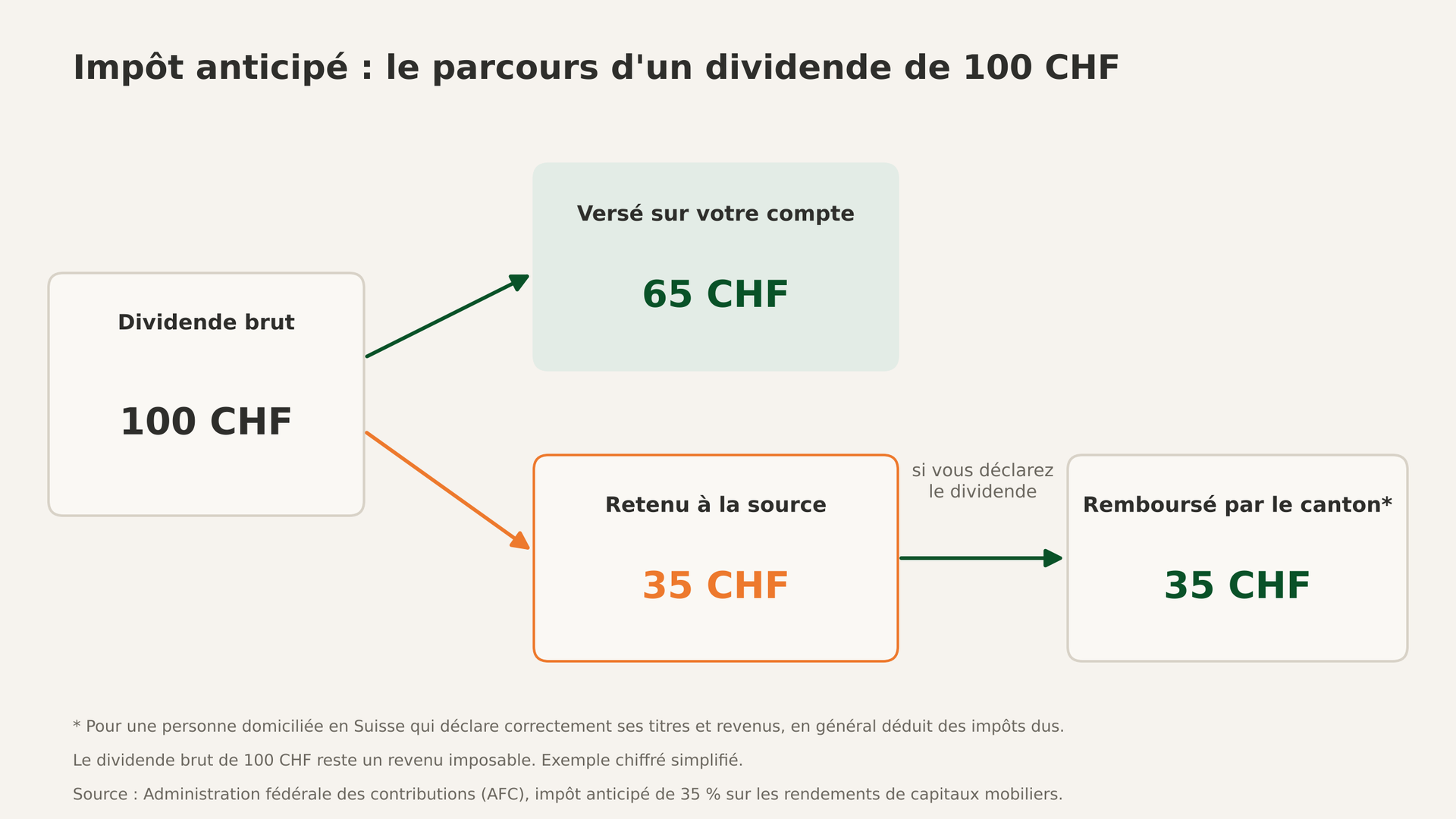
Getting the withholding tax back does not mean the dividend becomes tax-free, though. For a private investor living in Switzerland, the gross dividend is in principle taxable income.
What changes depending on whether you live in Switzerland
For a Swiss resident, everything is therefore settled in the tax return.
For a person living abroad, a double taxation agreement between Switzerland and their country of residence (an agreement to avoid the same income being taxed twice) may allow them to recover all or part of the amount withheld. Without such an agreement, the withholding tax is in principle lost.
Some Swiss companies known for their dividends
Three large Swiss companies show clearly that the same habit, raising their dividend every year, can take very different forms.
Nestlé, Roche and Novartis are part of the SMI, the index that brings together the 20 largest and most liquid Swiss stocks. They are among the best-known Swiss dividend stocks, and all three have been raising their dividend for a long time.
Nestlé focuses above all on consistency. For the 2025 financial year, shareholders approved in April 2026 a dividend of CHF 3.10 per share, up 5 centimes. According to its annual results, Nestlé has maintained or increased its dividend in Swiss francs over the last 66 years.
Roche follows a similar approach, with a higher amount per share. In March 2026, its shareholders approved a gross dividend of CHF 9.80, the group's 39th consecutive increase.
Novartis has a shorter but steady track record. In March 2026, the group paid a dividend of CHF 3.70 per share, up 5.7%, marking its 29th consecutive increase.
These examples are in no way a recommendation to buy. The amounts are not directly comparable, as share prices, profits and capital policies differ from one company to another.
Dividends are often presented as a source of passive income from investments. They are one possible source of regular income, along with distributing ETFs (funds listed on the stock exchange that pay out their income) or bonds. But this income is neither automatic nor guaranteed, since a company can reduce or cancel its payout. Before looking into it, it helps to know where to start as a beginner investor.
Conclusion
Understanding a dividend is therefore not just about looking at how much a company pays out.
It means learning to read what that payout says about its profits, its cash, its priorities and its ability to keep this policy going over time.
A high dividend is not necessarily a good dividend.
To practise today, pick a company you know:
- Find its dividend and its earnings per share in its latest annual report.
- Divide the first by the second to get its payout ratio.
- Compare the result with previous years.
Step by step, these figures will become familiar.
To get started: the Academy's Foundations programme, free, helps you lay the groundwork before going further with investing.
To go further: the AdvisorOne Diagnostic takes a few minutes to show you where you stand, with no commitment.
FAQ
Can you live off the dividends from your portfolio alone?
In theory, yes, if the capital, the level of payouts and the tax situation allow you to cover your expenses over the long term. In practice, this generally requires substantial wealth and a safety margin, because dividends can vary. Passive income from investments should therefore not be confused with guaranteed income.
Should you reinvest your dividends or take them in cash?
There is no one-size-fits-all answer. Reinvesting can strengthen the compounding effect over time, the same mechanism that explains why starting early matters more than starting with a lot. Taking the dividend in cash can make sense when an investor wants to use that income. The choice depends on your goals, investment horizon, need for cash, costs and tax situation.
Can a dividend fall or be cancelled?
Yes. Lower profits, a crisis, the need to strengthen the balance sheet or a change of strategy can lead a company to reduce or cancel its dividend. A history of regular payouts is therefore never a guarantee for the future.
Do ETFs pay dividends too?
Yes. Some ETFs pass on to investors the income they receive from the securities they hold: these are distributing ETFs. Others reinvest it directly within the fund, and these are called accumulating ETFs. The choice between the two mainly depends on what you want to do with that income.
️
⚠️ Important notice ⚠️
The information presented in this article is provided for purely informational and educational purposes. It does not in any way constitute a personalised recommendation, investment advice, an offer or a solicitation to buy or sell financial products.
Any investment decision should be made after a thorough analysis of your personal situation, your objectives and your risk profile, and may require the advice of an authorised financial adviser.
Past performance is no guarantee of future results. Investments involve risks, including the risk of capital loss.