
Because when it comes to investing, the most powerful variable is not the amount you put in. It is the length of time you leave it to work. By the end of this article, you will understand why every year of waiting has a real cost, and why investing early, even with little, profoundly changes the equation.
The belief that holds everyone back
Many people put off investing because they think they first need to have more. This idea has a history, and above all it has a cost that is rarely measured.
Where does this idea come from?
For decades, investing was presented as the territory of experts, heirs and those who already had "enough" to afford to take risks.
Neither school nor most families have passed on a financial culture that gives people the desire (or the permission) to start investing with little. As a result, many people go through life with a vague conviction that personal finances and investing are not for them yet.
It is one of the 7 most common financial mistakes we see: confusing "I'm not ready" with "it's not the right time".
In Switzerland, however, investing is becoming more widespread. According to BlackRock (2025), 16% of adults already hold ETFs, exchange-traded funds that bring together many companies, compared with 9% in 2022.
What this waiting really costs
Financial inaction is not neutral.
According to PostFinance, its savings account in CHF has paid no interest at all since August 2025. Money left there therefore gradually loses purchasing power as soon as prices rise.Financial inaction is not neutral.
Compound interest explained simply
Behind the power of time lies a simple mechanism, whose effects often go beyond what intuition suggests. Yet it is rarely taught at school.
A simple but counter-intuitive mechanism
Imagine a snowball at the top of a slope.
At first, it is small. It picks up a little snow with each turn. But the bigger it gets, the more snow it picks up with each roll. After a while, it is no longer the slope doing the work, it is the size of the snowball itself.
Compound interest works exactly like this. You invest a sum, and it generates gains. Those gains are added to the capital, and the following year, it is this new total that generates gains in turn.
This is what long-term returns are about: not a straight-line accumulation, but growth that speeds up.
Two profiles, a surprising result
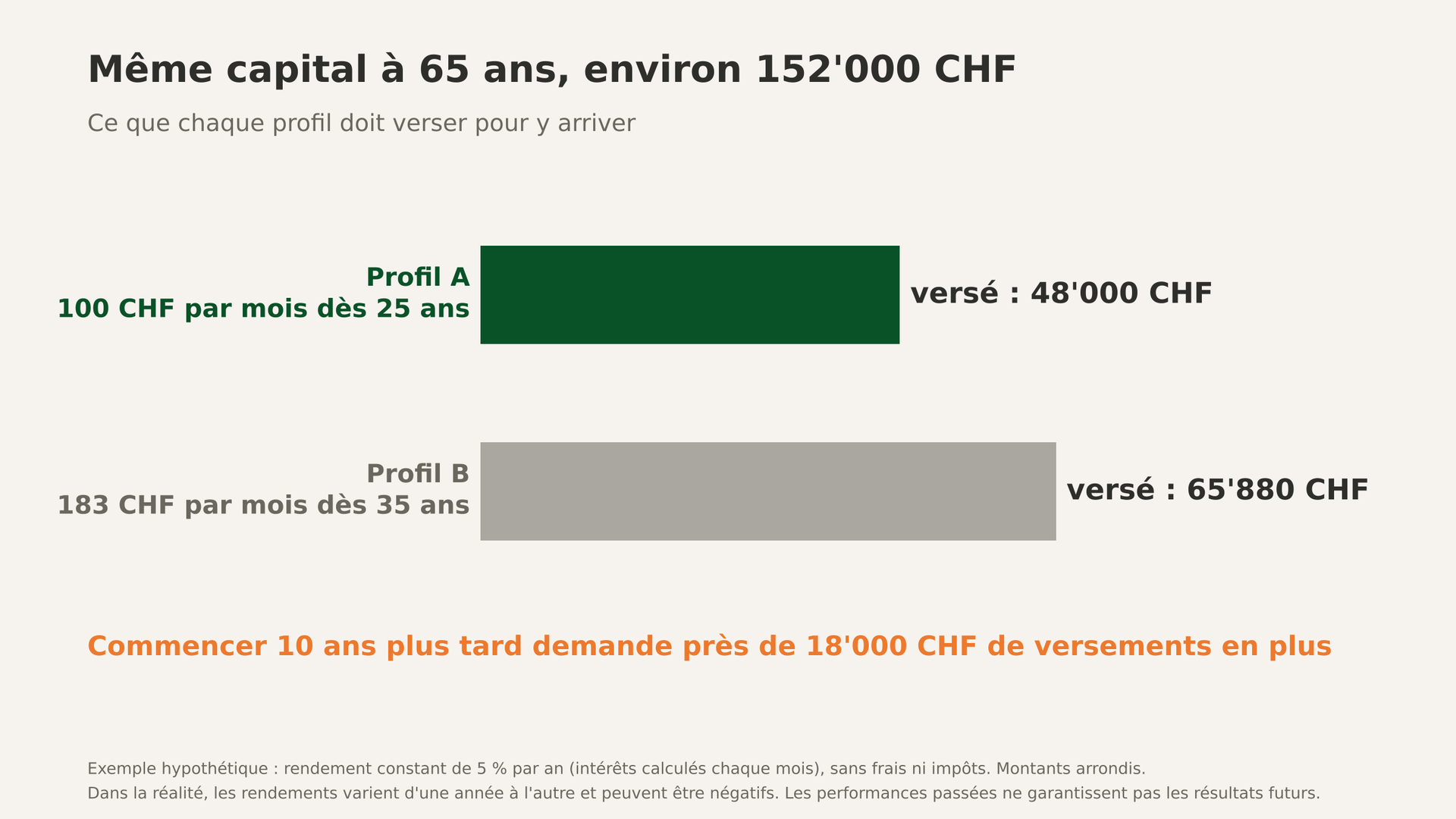
Here is an illustrative comparison, with a hypothetical return of 5% a year (indicative figures, with no guarantee of future performance).
Profile A and Profile B each invest CHF 100 a month. Profile A starts at 25, Profile B at 35. At 65, Profile A has about CHF 152,600, Profile B about CHF 83,200.
To catch up, Profile B would need to invest about CHF 183 a month, almost double. Not because Profile A made a bigger effort, but because they started earlier.
Why time does what money cannot do alone
Take the rule of 72: simply divide 72 by the average annual return to estimate how many years it takes for capital to double. At a 5% return, it doubles in about 14 years. With a savings account paying 0.1%, it would theoretically take nearly 720 years.
It is simple arithmetic, which favours those who start investing early and let time do its work.
What you actually lose with each year of waiting
The cost of waiting is invisible from day to day. Yet it can be calculated. A few simple figures are enough to show what a few years' delay represents.
The cost of doing nothing
With a hypothetical return of 7% a year, CHF 200 invested every month for 35 years comes to about CHF 360,000. The same amount invested over 20 years produces about CHF 104,000. The extra 15 years at the start therefore add about CHF 256,000, far more than the total amount paid in over the whole period (CHF 84,000).
This figure says something essential: in long-term saving, it is not the last years that make the performance. It is the first ones.
Waiting for the right moment is also a mistake
Waiting cannot be justified by looking for the perfect moment to enter the markets either. Nobody knows when the right moment is, not even professionals, and waiting for the right moment to invest often leads to never starting. What matters is being in the game, not finding the perfect entry point.
Starting small is a strategy, not a compromise
The starting amount often puts people off. Yet investing early with little is worth far more than waiting to have a lot. It is also the simplest way of getting started with investing.
What you can do with CHF 50 or 100 a month
The most common The most common psychological barrier is this one: "it's too little to be worth it."barrier is this: "it's too little to be worth it."
That is not true.
With a hypothetical return of 7% a year, CHF 100 invested at 25 is worth about CHF 1,500 at 65, thanks to time alone. Regularly investing small amounts also helps you learn in practice: how markets work, and how to get used to rises and falls.
Diversified ETFs let you invest in hundreds of companies at the same time, with very low fees and without any particular expertise.
Investing gradually
Getting started with investing does not mean solving everything at once.
You start with what you can. And as your income rises, your capacity to invest naturally rises too.
What matters is not starting big. It is starting and carrying on steadily and regularly.
The right questions to ask before you start
Before getting started, a few simple questions help avoid a lot of hesitation. They lay the foundations for real financial autonomy, built at your own pace.
What is my goal?
Investing "because you should" without knowing why rarely produces good results.
A concrete goal changes everything: building capital for a project, preparing for retirement, gradually building financial autonomy, reducing your dependence on a single income.
What is my time horizon?
Over 2 or 3 years, markets can fall without having time to recover. Over the very long term, the trend has been clearly positive. According to Pictet (2026), Swiss equities returned an average of 6.8% a year between 1900 and 2025. Your time horizon determines the level of risk you can reasonably accept.
Where do you actually start?
Before choosing a product, a platform or a strategy, there is one step nobody can skip: understanding your own situation.
A simple order helps you move forward without putting yourself at risk.
- Take stock of your income, your spending and what you own.
- Build a reserve for unexpected expenses.
- Pay off your consumer debt.
- Only then, invest a small regular amount.
Conclusion
Time is the most precious resource in investing.
You can earn more money. You can learn faster. But the years spent waiting can never be recovered.
Investing early, even with little and without understanding everything yet, means giving your money the one fuel nobody can buy later: time. That said, it is never too late to start. At any age, every year you give to time counts.
To take a first step today, choose an amount you could set aside each month without putting yourself under strain, even CHF 50, and note down what it will be for.
To get started: the Academy's Foundations programme, free, is the first and simplest step to lay the groundwork for your financial freedom.
To go further: the AdvisorOne Diagnostic takes a few minutes to show you where you stand.
FAQ
Can you really invest with little money?
Yes. The starting amount matters less than consistency and time. In Switzerland, options such as pillar 3a in securities or ETF savings plans let you start with a few dozen francs a month. What matters is building the habit and letting time do its work.
What is the ideal age to start investing?
As early as possible, because it is time that gives compound interest its full power. Starting at 25 rather than 35, with the same monthly effort, can almost double the final capital. The best moment is often now, once the basics are in place: a clear budget, a reserve for unexpected expenses and no consumer debt.
How much should you set aside each month to invest?
There is no universal figure. What matters more than the amount is consistency. Even CHF 50 a month is a valid starting point, as long as you keep it up over time and gradually increase it as your income rises.
Why is compound interest so powerful?
Because it creates growth that speeds up over time. The gains generated are added to the capital, and this new total itself generates gains the following year. With a hypothetical return of 5% a year, capital doubles in about 14 years.
How do you know where to start if you know nothing about finance?
With your own situation: what you earn, what you spend, what is left. Before choosing an investment product, having this clarity is essential. Noting down these three figures for a month is often enough to see much more clearly, without jargon or complicated tools.
⚠️ Important notice ⚠️
The information presented in this article is provided for purely informational and educational purposes. It does not in any way constitute a personalised recommendation, investment advice, an offer or a solicitation to buy or sell financial products.
Any investment decision should be made after a thorough analysis of your personal situation, your objectives and your risk profile, and may require the advice of an authorised financial adviser.
Past performance is no guarantee of future results. Investments involve risks, including the risk of capital loss.