
The problem is not that this reasoning is absurd. Of course it seems prudent, logical and reasonable. Yet over the long term, it can be very costly. Behind this apparent caution lies a far more ordinary fear: the fear of starting.
The myth of the right moment
People often imagine there is an ideal moment to enter the markets, and that experts know how to spot it. The figures show that this moment remains impossible to find, even for them.
Nobody knows when the right moment is, not even the experts
There is a widespread idea that finance professionals know when to invest and when to wait.
The figures tell a different story. According to S&P Dow Jones Indices (2026), over ten years, nearly 89% of actively managed Swiss equity funds did worse than their benchmark index (the basket of companies they are trying to beat), as did more than 95% of European and global equity funds denominated in euros.
This is all the more striking given the considerable resources they have: teams of analysts, sophisticated tools and constant access to the markets.
To date, no method has proven able to consistently identify the best moment to invest. If the best-equipped professionals cannot do it over time, waiting for the ideal context is unlikely to become an effective strategy.
Not deciding is also a decision
Inaction is not a neutral position.
Every month spent waiting is a month in which your money is not working. According to MSCI, the MSCI World index, which brings together large companies from 23 developed countries, has risen by about 9% a year on average since the end of 1987 (in dollars, with dividends reinvested). In other words, 1 dollar invested back then would be worth about 28 today, despite economic crises, stock market crashes and recessions.
Waiting does not remove risk. It simply replaces one risk with another: that of missing years of potential growth.
Why do we really wait?
If waiting is so costly, why is it so common? This reflex has a name: financial procrastination. It is driven by our emotions, but also by cognitive biases, those mental shortcuts well known in finance that distort our decisions.
The fear of an irreversible mistake
Most investors are not trying to maximise their gains. Above all, they are trying to avoid regretting their decision. This is often where the fear of investing begins.
In an analysis published in 2026, Vanguard imagined the unluckiest investor possible. From 1997 onwards, he invested EUR 45,000 in seven instalments, each time just before a major stock market crash. The result: at the end of May 2026, he had nearly EUR 170,000. Left in a bank account, the same money would have grown to only about EUR 57,000.
Even by always choosing the worst moment, he almost quadrupled his money, simply because he stayed invested.
The truly irreversible mistake is not investing at the wrong moment. The real mistake is often putting off the decision.
The need for certainty in a world that offers none
Many people wait for markets to settle down before they start investing.
The problem is simple: that moment never comes.
There will always be an election, a geopolitical crisis, a forecast recession or some economic worry. Uncertainty is not an exception in financial markets. It is part of how they normally work.
The information paradox
Today we have access to more financial information than ever.
Yet this abundance of information does not always make decisions easier.
Every expert has their own analysis. Every forecast is contradicted by another. Some announce a rebound while others predict an imminent fall.
Without a clear method, piling up information usually ends up creating confusion rather than clarity.
What the data show about timing
Beyond emotions, figures help measure what waiting really costs. They also show that there is a simple way of investing without having to guess the right moment.
The real cost of waiting
The best days on the stock market often occur during periods of high volatility, that is, when prices swing sharply from one day to the next.
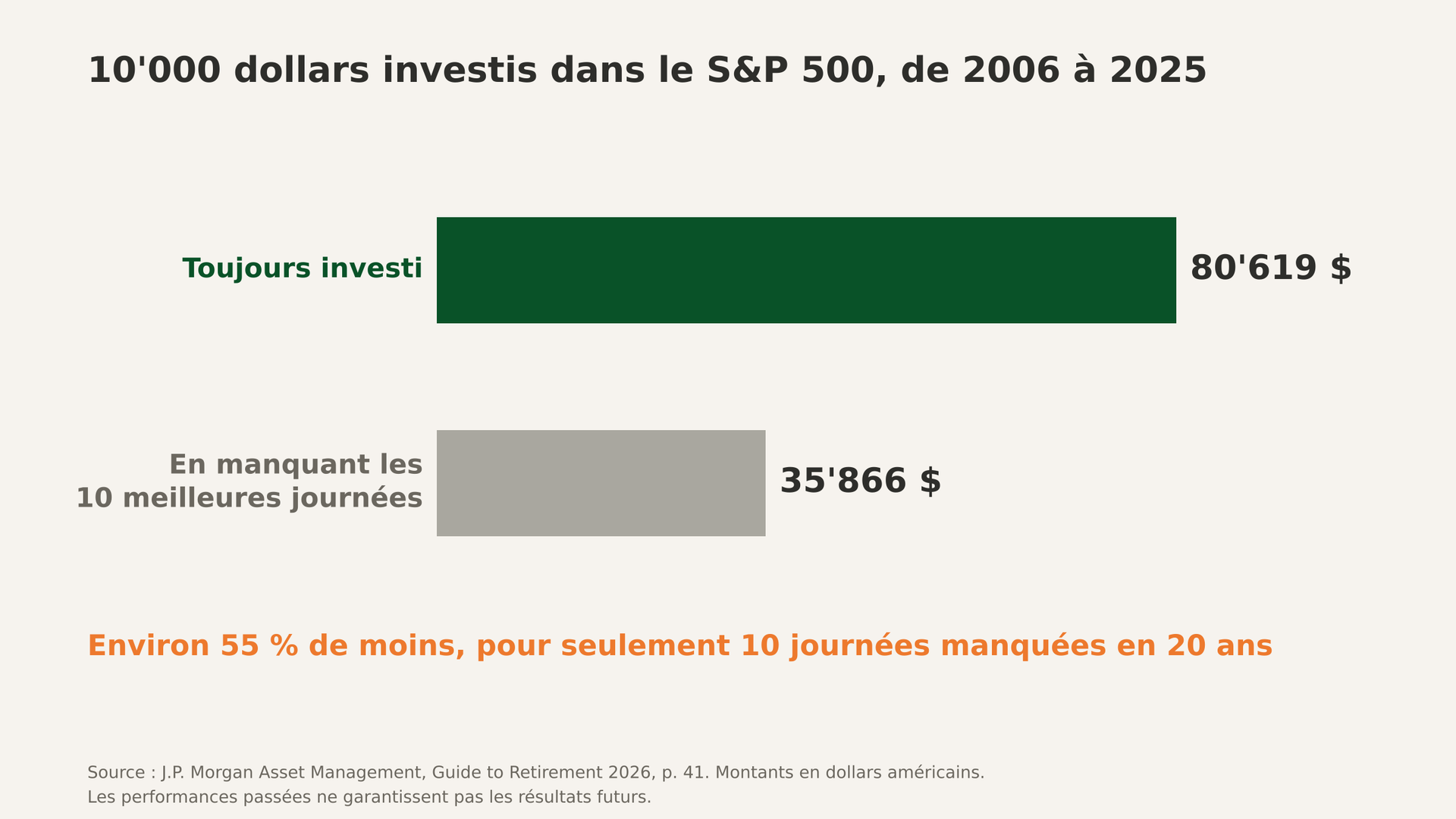
Investors who leave the markets to wait for better days therefore risk missing the biggest rebounds. According to J.P. Morgan Asset Management (2026), over the last twenty years, 6 of the 10 best days of the S&P 500 (the index of the 500 largest US companies) came less than two weeks after one of the 10 worst. And a few exceptional days can account for a significant share of a portfolio's total performance: USD 10,000 invested from 2006 to 2025 would have become USD 80,619, but only USD 35,866 if the 10 best days were missed.
Five years of waiting may seem harmless today. Over a horizon of twenty or thirty years, however, they can make a considerable difference. With a hypothetical return of 5% a year, CHF 10,000 invested for 30 years would grow to about CHF 43,200, compared with about CHF 33,900 if invested for only 25 years.
Investing regularly rather than looking for the right moment
There is a simple alternative to market timing, which means trying to guess the best moment to get in or out of the market: investing gradually, also known as dollar-cost averaging (DCA).
The principle is to invest a fixed amount at regular intervals, whatever the markets are doing. When markets fall, this amount buys more units, and when they rise, the investments already made gain value.
Dollar-cost averaging is the approach used by many investors who gradually build a portfolio of diversified ETFs, funds that bring together many companies in a single investment.
How do you stop waiting?
Getting out of the waiting game requires neither large capital nor expert knowledge. Two levers are often enough: starting with a small amount, and giving yourself a clear framework.
Start small, but start
The hardest part is not having the amount to invest: it can be very small. What is difficult is taking action.
Once your reserve for unexpected expenses is in place, investing CHF 10 is already enough to build a habit and start benefiting from the most precious factor in investing: time. That is also why starting early matters more than how much you start with.
Give yourself a framework rather than waiting for perfect conditions
The right moment is not found in the economic news.
It is built through a clear strategy: defining your goals, your investment horizon, how much you can save and the level of risk you can accept.
Once this framework exists, decisions become simpler. They depend less on the news and more on your personal situation.
Conclusion
The right time to invest is not a date marked on the calendar.
Markets will always be uncertain. Nobody can predict the right moment, not even professionals, and staying invested over time matters far more than the day you start. In fact, waiting for the right time to invest is one of the most common financial mistakes.
To take a first step today, choose a small amount you could invest each month without putting yourself in difficulty, and note down the date when you want to start.
The only thing nobody can get back is the time already spent not investing.
Everything else can be adjusted.
Time cannot.
To get started: the Academy's Foundations programme, free, helps you lay the groundwork before going further with investing.
To go further: the AdvisorOne Diagnostic takes a few minutes to show you where you stand.
FAQ
Can you invest when markets are unstable?
Yes. Markets regularly go through periods of volatility. Over the long term, the length of time invested and diversification have historically had more impact on results than the context at the time of purchase. What matters is investing money you will not need in the short term.
Is it better to invest in one go or gradually?
Both approaches can be defended. When you already have a sum available, investing gradually reduces the importance of investment timing. This approach helps smooth the purchase price over time and can be more comfortable psychologically for many investors. According to Vanguard (2023), however, investing in one go did better in about two thirds of cases, because the money starts working sooner.
What is DCA?
DCA means investing a fixed amount at regular intervals, for example CHF 200 every month. This method means investing regularly without trying to anticipate market movements, and it encourages lasting investment discipline. It is easy to automate with a standing order.
How can you invest without waiting for the right moment?
The best approach is often to define a clear strategy and then apply it regularly. Waiting for perfect conditions often leads people to put off their decisions for months, or even years. Setting your amount, frequency and horizon in advance means you no longer depend on the news.
Is it risky to start investing today?
As with any investment, there is a risk of capital loss. However, staying out of the markets all the time can also have a cost, by losing time and long-term growth opportunities. A long horizon and good diversification help keep this risk under control.
⚠️ Important notice ⚠️
The information presented in this article is provided for purely informational and educational purposes. It does not in any way constitute a personalised recommendation, investment advice, an offer or a solicitation to buy or sell financial products.
Any investment decision should be made after a thorough analysis of your personal situation, your objectives and your risk profile, and may require the advice of an authorised financial adviser.
Past performance is no guarantee of future results. Investments involve risks, including the risk of capital loss.