
Here is how it works in practice, how the price of a share is formed and what really moves the markets.
What does it mean for shares to be listed?
Shares are units of a company's capital, issued in exchange for the money its shareholders put in. Their price changes according to the buy and sell orders placed by investors.
A share is said to be "listed on the stock exchange" when it can be traded on an organised financial market. A stock exchange listing is therefore the mechanism that determines and publishes the price at which a share is bought or sold at a given moment. This price is not set arbitrarily by the company: it results from the meeting of supply and demand on the market.
What is an initial public offering (IPO)?
An initial public offering, or IPO, is the operation through which a company's shares are offered to the public for the first time and admitted to trading on a stock exchange.
The operation can involve:
- new shares issued by the company, in order to raise capital
- existing shares sold by some of the current shareholders
- or a combination of the two
Private investors can then buy them, and the company's shares start trading on a public stock exchange.
Until it goes public, a company remains a private company. At that stage, its shareholders are generally a small circle: the founders, people close to them, and professional investors such as venture capital funds, which finance young companies, or business angels, private individuals who invest their own money in them.
The price offered at the IPO is based on a prior analysis of the company, its financial situation, its prospects and the interest shown by investors. Once the operation is complete, the shares concerned are admitted to trading. Part of the capital becomes available to the public, subject to any lock-up periods during which certain shareholders cannot sell. According to the SIX IPO guide, these usually last between six and twenty-four months.
Why does a company go public?
The first reason is money. The same guide explains that a listing gives a company direct and ongoing access to capital to grow or to buy other companies. It also creates a market where shares can easily change hands, so the founders and early investors can sell part of their holdings.
A listed company can also offer shares to its staff to keep them on board, pay for an acquisition with its own shares and gain visibility.
Why do some companies prefer to stay private?
There is a price to going public. Preparing an IPO takes a lot of time and resources. Once listed, a company must publish its accounts every six months, announce without delay any information that could affect its share price and follow strict governance rules.
It also shares its capital with shareholders it does not choose. For some family businesses, these constraints outweigh the benefits.
Can every company go public?
No. Each stock exchange sets minimum requirements. On the Swiss stock exchange, the listing requirements include three years of accounts, at least CHF 25 million in equity, meaning resources that belong to the company itself, and at least 20% of its shares in the hands of the public.
For SMEs, SIX offers a segment called Sparks, with lighter requirements: two years of accounts, CHF 12 million in equity and at least 15% of shares spread across 50 or more investors.
How does share trading work in practice?
Once a company is listed, two main trading methods exist side by side on the markets. Which one applies depends on how often the shares are traded and on each exchange's rules.
Continuous trading
Continuous trading applies to most listed companies, especially large caps: companies whose stock market value is among the highest on the market and whose shares trade in large volumes. This is the case, for example, for the shares of the large companies that make up indices such as the SMI, the CAC 40 or the S&P 500.
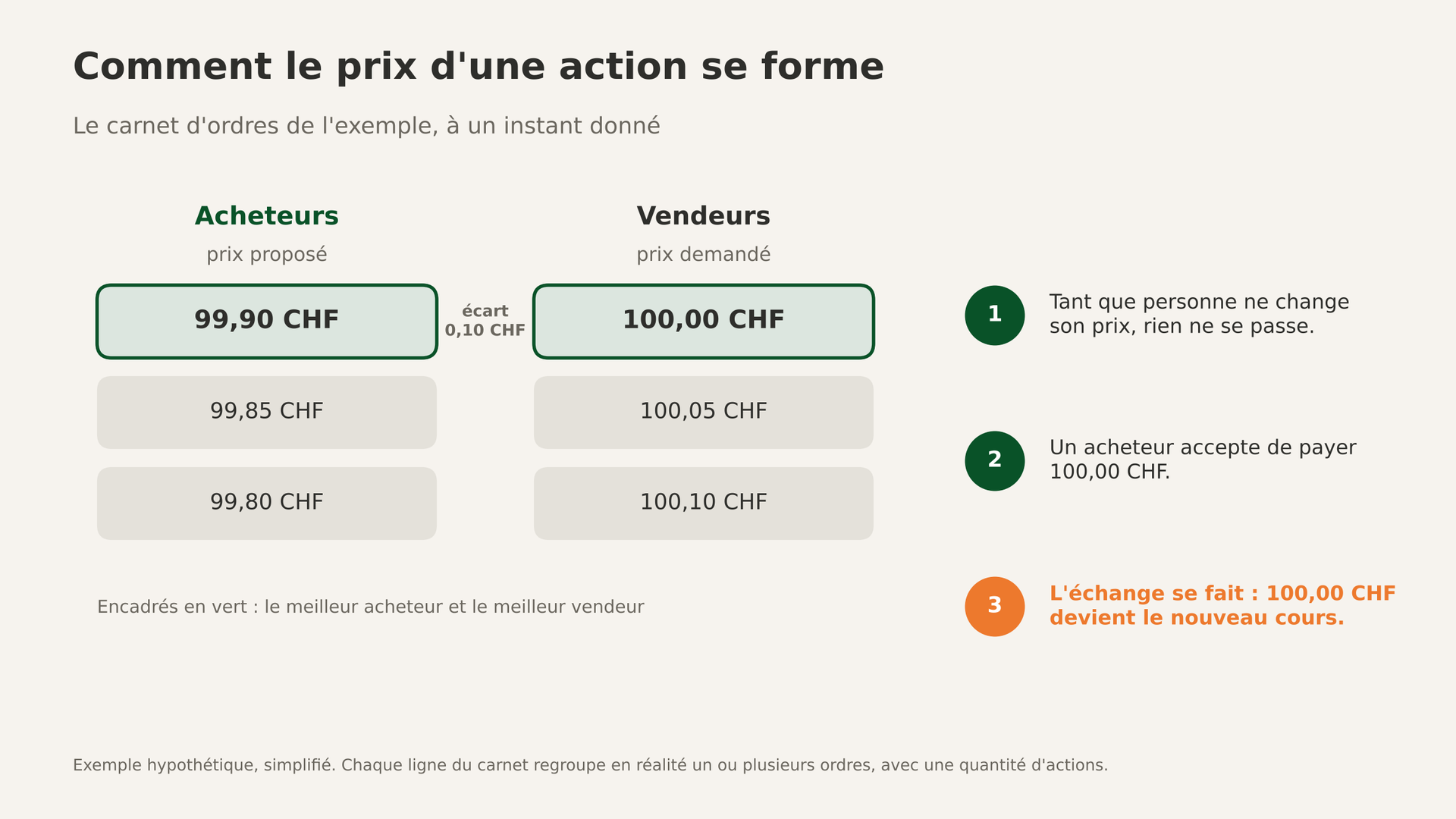
The order book brings together the prices at which investors want to buy and sell the share. When a buy order meets a matching sell order, a trade is executed. The price of that trade then becomes the new share price.
For example, the best buyer offers CHF 99.90 and the best seller asks for CHF 100. As long as neither changes their price, no trade takes place. If a buyer finally agrees to pay CHF 100, the trade is executed at that price.
Auction trading
On some markets, auction trading, known in French as "fixing", mainly concerns smaller companies, or "small caps": companies with a more modest market value whose shares trade much less often. These less liquid shares, which are harder to buy or sell, are then traded through an auction system held at set times.
On the Swiss stock exchange, shares trade continuously during the session, but auctions also play a role. Under the SIX trading rules, the day opens with an auction and ends with another one, the closing auction, which sets the closing price.
What factors affect share prices?
A share price reacts to a great deal of information, whether specific to the company or linked to the economy in general. Here are the main factors affecting share prices.
- The general economic environment, including interest rates, inflation and growth
- The political situation, through elections, reforms or the risk of geopolitical tension
- Exceptional events, such as natural disasters or health crises
- Company-specific information, such as its results, prospects, level of debt, a product launch, a change of management or an acquisition
- Investors' expectations: a company can publish good results and still see its share price fall if the market was hoping for even better figures
Changes in a share price directly affect the performance of a portfolio. When the price rises, the investor records an unrealised gain, in other words a gain that exists only on paper, and an unrealised loss when it falls. These gains or losses become realised when the shares are actually sold.
Understanding these factors does not make it possible to predict the market, but it helps you interpret the movements in your portfolio rather than react in a hurry to every change. If all this still feels abstract, don't worry: that is normal when you are new to investing.
Conclusion
Nobody in particular decides the price of a share. It comes from the meeting of those who want to buy and those who want to sell.
An IPO opens that market for the first time. After that, continuous trading or auctions organise the trades, and the share price reacts to the company's results, the economy and investors' expectations.
To take a first step today, open the page of a share you know on your trading platform or e-banking. Find the best buying price, the best selling price and the gap between the two.
A moving share price is no longer a mystery once you know where it comes from.
To get started: the Academy's Foundations programme, free, is the first and simplest step to lay the groundwork for your financial freedom.
To go further: the AdvisorOne Diagnostic takes a few minutes to show you where you stand, with no commitment.
FAQ
What does it actually mean for a company to be "listed on the stock exchange"?
It means its shares can be freely bought and sold on an organised financial market, at a price that changes according to investors' supply and demand. The same goes for ETFs, funds that are bought and sold on the stock exchange just like listed shares.
What is the difference between an IPO and simply buying shares on the market?
An IPO is the one-off event in which a company opens its capital to the public for the first time and starts trading on the stock exchange. Buying shares afterwards, on an ordinary trading day, simply means acquiring existing shares from other investors on the market.
What is really the difference between continuous trading and auction trading?
Continuous trading allows matching buy and sell orders to be executed throughout the session, and the price changes with every new trade. An auction collects orders over a set period, then sets at a specific time the price that allows the largest possible number of trades. The number of auctions depends on the market concerned.
Can the price of a listed share change outside market hours?
The main reference prices are set during official trading hours. Depending on the market and the broker used, however, some trades can take place before the opening or after the close of the main session. These periods are generally less liquid and can show larger price gaps.
Does a share price always reflect the real value of the company?
Not necessarily. The share price reflects what investors are prepared to pay at a given moment, which depends on their expectations, the general market climate and outside events, and not only on the company's financial fundamentals. It can therefore move away from that value, upwards or downwards, sometimes for a long time.
⚠️ Important notice ⚠️
The information presented in this article is provided for purely informational and educational purposes. It does not in any way constitute a personalised recommendation, investment advice, an offer or a solicitation to buy or sell financial products.
Any investment decision should be made after a thorough analysis of your personal situation, your objectives and your risk profile, and may require the advice of an authorised financial adviser.
Past performance is no guarantee of future results. Investments involve risks, including the risk of capital loss.