
In Switzerland, people lived for a long time with inflation close to zero, sometimes even below it. Then came 2022, with a rise in prices that many had never experienced in their adult lives. That moment was a reminder of a simple reality: money left idle doesn't just earn nothing. It loses value. Understanding how inflation interacts with your investments means understanding why investing is not only about gains, but sometimes simply about not becoming poorer.
What is inflation and how is it measured in Switzerland?
Inflation is a general rise in the price level. What counts is the average change in the prices of the goods and services that households consume.
If a basket of goods costs CHF 1,000 today and prices rise by 2%, you will need about CHF 1,020 the following year to buy the same thing. That is what a loss of purchasing power means, and it is the starting point for any thinking about inflation and investments.
The consumer price index (CPI) and how it is calculated
In Switzerland, the benchmark is the Swiss consumer price index (CPI), calculated every month by the Federal Statistical Office (FSO). It tracks the prices of a basket that reflects what households consume: housing, food, transport, leisure, clothing and communications.
The CPI is an average. A household that spends a large share of its budget on rent, energy or transport can feel rising prices much more strongly than the average.
Swiss inflation compared with European inflation: why the difference?
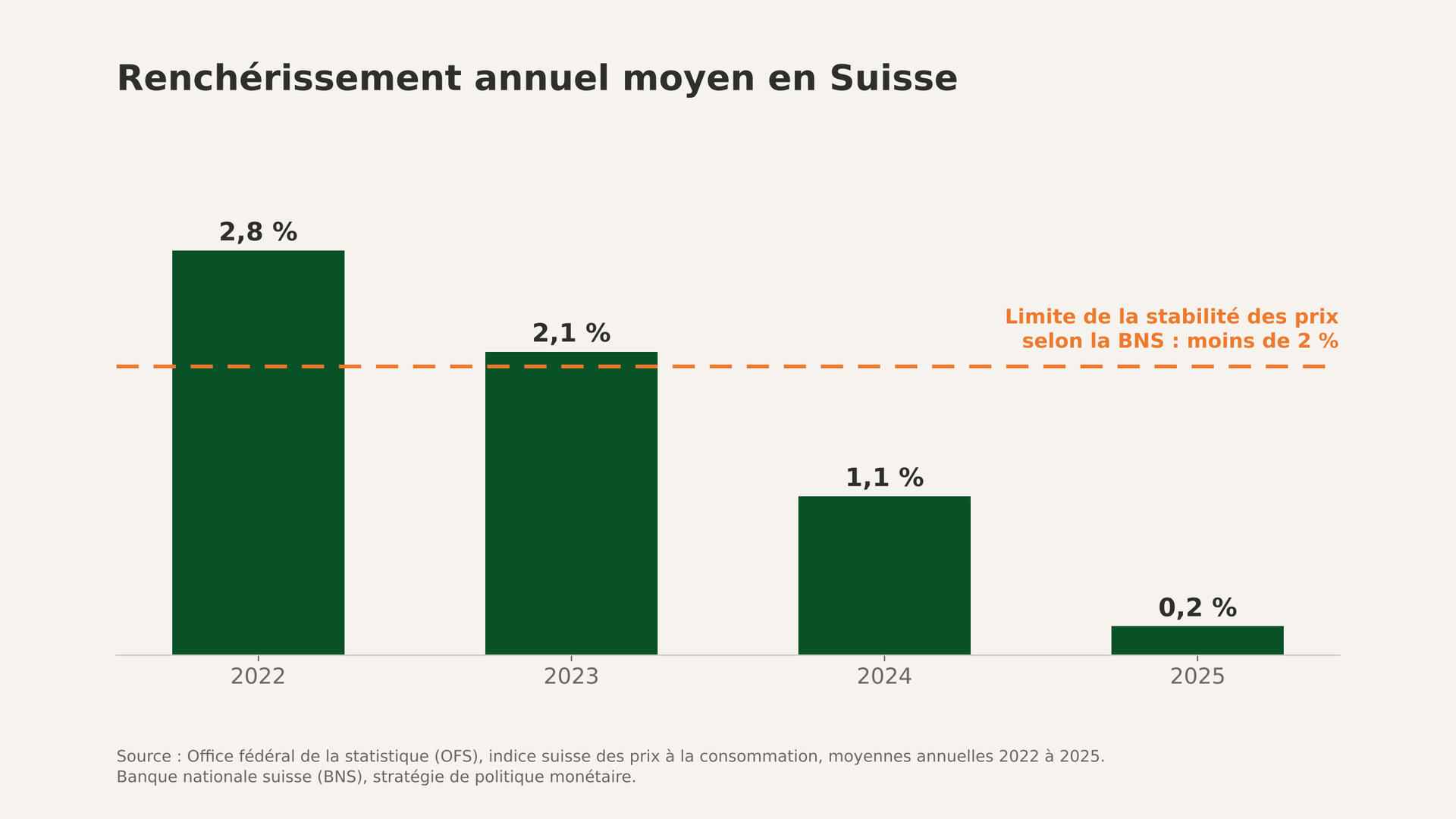
In Switzerland, average annual inflation was still negative in 2020, with prices falling by 0.7%. According to the FSO, it then reached 2.8% in 2022 before easing to 2.1% in 2023. These levels were unusual for Switzerland, but well below the euro area, where the European Central Bank reports average inflation of 8.4% in 2022. Since then, Swiss inflation has fallen sharply, to 1.1% in 2024 and then 0.2% in 2025.
The Swiss franc may also have played a part in this gap. In its 2023 annual report, the Swiss National Bank (SNB) explains that it countered inflationary pressure by raising its policy rate and selling foreign currency, which supports the franc. A stronger franc makes imports cheaper, which can limit imported inflation.
Nominal return vs real return: a key distinction
The nominal return is the one you see on your statement. The real return is what is left once inflation has been taken into account.
Earning 2% when inflation is 3%: you lose money
Imagine you invest CHF 10,000 at 2% a year. After one year you have CHF 10,200, an apparent gain of CHF 200.
But if prices have risen by 3% over the same period, what cost CHF 10,000 now costs about CHF 10,300. Your capital has grown in francs, but more slowly than prices. You are richer on paper, but slightly poorer in purchasing power.
How to calculate your real return after inflation
For a first approximation: real return ≈ nominal return minus inflation. An investment earning 4% with inflation at 2% therefore offers a real return of about 2%, before fees and taxes. Using Swiss figures, an account paying 0% lost about 0.2% of its purchasing power in 2025, but about 2.8% in 2022.
Thinking in terms of real return mainly changes your perspective: the aim is not only to see your capital grow in francs, but to know what it will buy tomorrow.
How different asset classes react to inflation
There is no such thing as a perfect inflation-proof investment. Each asset class reacts differently depending on where inflation comes from, how long it lasts, how interest rates move and how long you plan to invest.
Equities: partial protection over the long term
Some companies can pass on at least part of their rising costs through their selling prices. Their revenues and profits can then move with the general price level. Over long periods, equities can therefore help preserve purchasing power.
But they don't rise automatically when inflation goes up. In the short term, high inflation can even weigh on markets: rising costs, weaker consumer spending, higher interest rates. Equities are therefore best approached with a long-term view and as part of a diversified portfolio.
Bonds: directly exposed to inflation
Take a bond that pays fixed interest of 1% a year. If inflation rises to 3%, that income stays the same while prices rise faster: the real return turns negative.
What's more, when a central bank raises rates to fight inflation, older bonds paying less interest become less attractive, and their market value can fall. Not all bonds react in the same way, though. The maturity, the interest rate, the quality of the issuer or any link to inflation all make a difference.
Property, gold and commodities: safe havens with caveats
Property is often presented as protection, because rents and property values can follow the price level over the long term. But it also depends heavily on interest rates, borrowing, location and the local market.
Gold is regularly described as a safe haven and can help diversify a portfolio in uncertain times. But its price fluctuates strongly, and it pays no income. Commodities, for their part, can rise during an inflation shock, especially when energy is the cause, but they remain very volatile.
Cash: purchasing power that slowly erodes
Cash has one essential quality: it is available. A reserve for unexpected expenses remains essential, whatever the level of inflation.
But CHF 10,000 left for ten years in an account that pays no interest, with inflation of 2% a year, will still show CHF 10,000 on paper, while buying only the equivalent of about CHF 8,200 today.
So the question is not choosing between savings and inflation, nor investing all your savings. It is about separating the money you will need in the short term, which should stay available, from the money set aside for the long term, where the question is how to protect your purchasing power.
The role of the SNB in fighting inflation
The Swiss National Bank plays a central role in keeping inflation in check. Its mandate, its tools and its decisions directly affect the savings and investments of private individuals.
What the SNB means by price stability
In its monetary policy strategy, the SNB defines price stability as a rise in the consumer price index of less than 2% a year. A sustained fall in prices, known as deflation, also runs counter to this objective.
How Swiss monetary policy influences prices
The SNB's main tool is the SNB policy rate, the benchmark interest rate it sets. When inflation becomes too high, it can raise this rate: borrowing becomes more expensive, households and businesses borrow and spend less, and this slows the rise in prices. Conversely, it can lower the rate to support the economy.
What SNB decisions mean for individual investors
SNB decisions influence the interest paid on savings accounts, bond yields, the cost of mortgages, share valuations, the property market and the value of the franc.
Does that mean you should adjust your portfolio after every announcement? Generally not. A strategy that fits your time horizon and goals is better than trying to anticipate each decision, a reflex that shows why waiting for the right moment to invest is often a mistake.
Conclusion
Inflation can seem abstract, but it directly affects our savings and long-term plans. The answer is not to hunt for "the best investment against inflation". It is to separate emergency savings from long-term capital, to think in terms of real return, and then to build, step by step, a diversified strategy that fits your goals.
To take a first step today, look up the interest rate on your savings account and compare it with the latest inflation figure published by the FSO. The difference is your real return.
Understanding inflation is already a way to better protect what you have built.
And if you are starting from a long way back, the first steps towards financial freedom follow the same order: a reserve first, investing afterwards.
To get started: the Academy's Foundations programme, free, helps you lay the groundwork for your financial freedom.
To go further: the Academy's one-on-one support helps you address specific financial questions and structure important decisions with clarity.
FAQ
What inflation rate is considered normal in Switzerland?
A rise in prices of less than 2% a year, without lasting deflation: this is how the SNB defines price stability. So the goal is not zero inflation. Even when it is low, though, inflation should be taken into account whenever you save or invest over several decades.
How can I tell if my portfolio is protected against inflation?
There is no single test. You need to look at your investment horizon, the share of cash, diversification, fees and the real return you are aiming for. A "protected" portfolio does not rise every time inflation goes up: it aims to preserve purchasing power over time, while respecting your risk profile.
Is gold really a hedge against inflation?
Sometimes, but not consistently. Gold has served as a store of value during some crises, but its price can also fall while prices are rising. It is one asset class among others, not insurance against inflation. Its place in a portfolio depends on each person's goals and risk profile.
Can inflation go back to zero after a period of rising prices?
Yes. The inflation rate measures how fast prices are rising, not how high they are. Inflation of 0% means that prices stop rising, not that they return to where they were before. For prices to actually fall, there would need to be a period of deflation.
⚠️ Important notice ⚠️
The information presented in this article is provided for purely informational and educational purposes. It does not in any way constitute a personalised recommendation, investment advice, an offer or a solicitation to buy or sell financial products.
Any investment decision should be made after a thorough analysis of your personal situation, your objectives and your risk profile, and may require the advice of an authorised financial adviser.
Past performance is no guarantee of future results. Investments involve risks, including the risk of capital loss.