
But some of the first financial decisions you take between 20 and 30 carry a weight that nobody points out. Not spectacular decisions. What matters most are the non-decisions: not saving yet, putting off investing, or not looking too closely at where the money goes. It is these silent habits that, 10 or 20 years later, make all the difference.
Understand where your money comes from and where it goes
Before saving or investing, you need to know what is happening in your account. A simple personal budget and a clear-eyed look at your spending are often enough to change things.
Your first real personal budget
Seeing your situation as it really is happens less often than you might think. Many young workers know roughly what they earn. Very few know exactly what they spend. The difference between the two is the grey area where money disappears without anyone knowing exactly how.
At 20, a budget is not a constraint. It is a map: it does not decide for you, it shows you the ground you are moving on. The idea is to see your fixed income, recurring costs, variable spending and what is left. Putting this down in black and white, just once, drastically changes the way you look at your money.
The lifestyle inflation trap
A first permanent contract often brings career progress, but also a rise in income. With each pay rise, spending tends to rise too: a slightly more comfortable home, more evenings out or more frequent purchases. This phenomenon, known as lifestyle inflation, is natural.
The problem arises when every rise in income is entirely absorbed by your standard of living. In that case, your salary goes up, but your financial situation does not really improve. Building good habits early helps avoid this drift, the one that explains how people can earn good money yet fail to save for years.
Start saving, even a little
Saving does not begin on the day you earn more. It begins with a small regular amount, and a reserve for unexpected expenses before you even think about investing.
Why the amount matters less than the habit
CHF 50 a month can sometimes seem insignificant. Yet it already adds up to CHF 600 over a year, and above all, it creates a habit.
Most people think they will start saving once they earn more. In practice, those who develop this reflex early often find it much easier to increase the amounts they save later on.
The habit matters more than the figure itself.
The emergency fund comes before everything else
Before investing, there is an underestimated step: building a safety reserve, often called an emergency fund. The aim is not to make this money grow, but to be able to cope with the unexpected.
A car breakdown, a job loss, a medical expense or an unplanned move can quickly throw a financial situation off balance. Having a few months of regular expenses set aside lets you make decisions with much more peace of mind.
Understand how money can work for you
Once the foundations are in place, the money you have set aside can start working. You do not need to be an expert, or to have a lot. Above all, you need time and a bit of method.
Time is the one advantage young people have over everyone else
At 20, you do not necessarily have significant wealth. But there is one resource nobody can buy later: time.
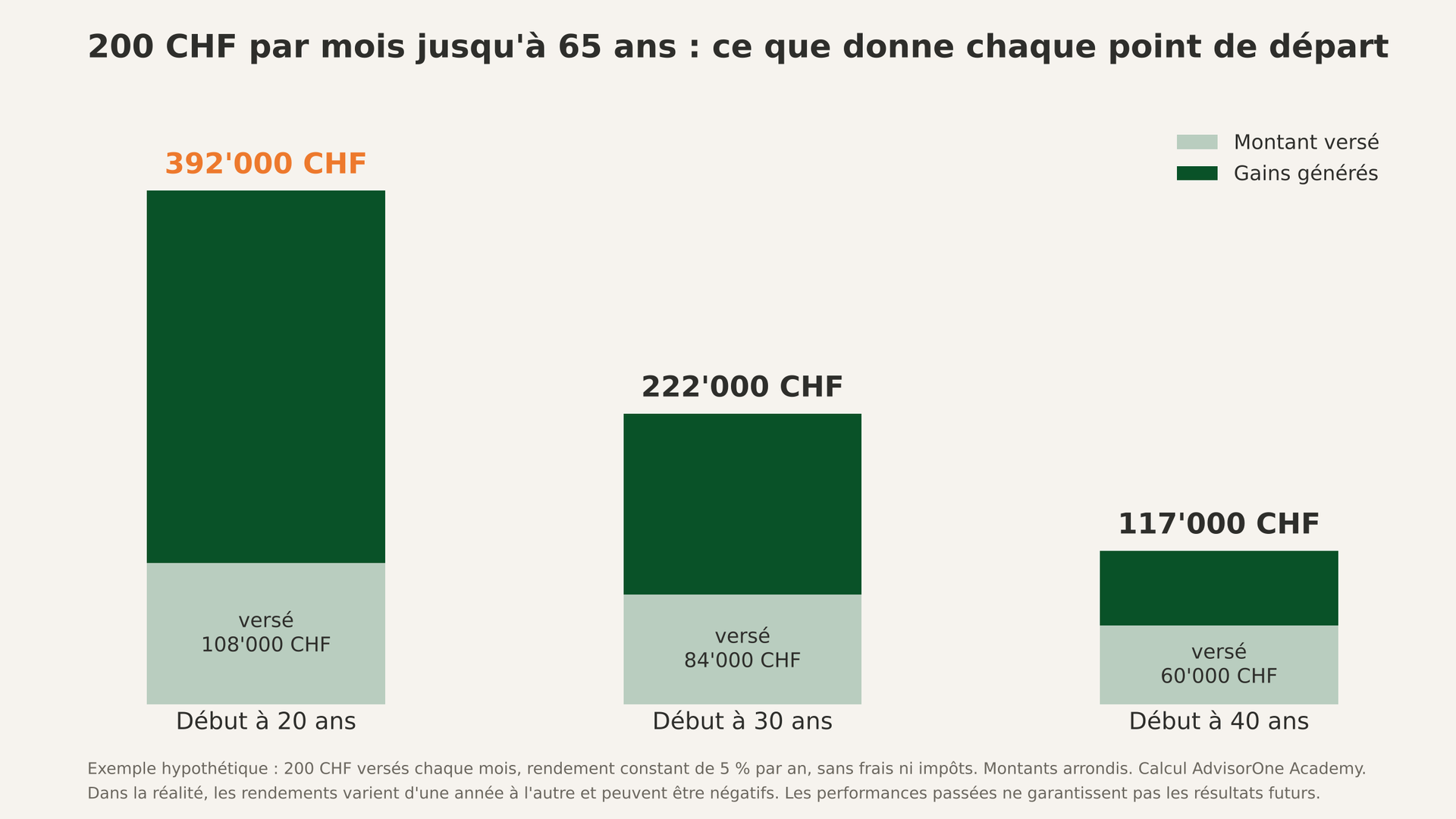
Time is the real engine of compound interest. Each extra year lets the gains you have made generate new gains in turn.
The MSCI World, which brings together the main listed companies in developed countries, has risen by about 9% a year on average since the end of 1987, according to MSCI (in dollars, with dividends reinvested), despite crises, recessions and periods of uncertainty. The earlier you start investing, the more time can play its part. That is why starting early matters more than starting with a lot.
Don't wait until you know everything to start
Finance often gives the impression that you need to understand everything before taking the first step. In reality, learning happens gradually. The aim is not to become an expert straight away, but to understand what you are doing and why you are doing it.
ETFs (exchange-traded funds), for example, let you invest in a whole group of companies rather than a single one. Before buying any, it is better to understand what an ETF is, how it works and what risks it carries, even over the long term.
In Switzerland, another decision comes with your first job: opening a pillar 3a, private retirement savings whose contributions are tax-deductible. In 2026, an employee with a pension fund can pay in up to CHF 7,258 a year, according to the Federal Tax Administration. There is no obligation to pay in the maximum, and retirement planning for young workers can also be built with small amounts.
Mistakes to avoid at all costs at this age
Some mistakes are costly at 20, because their effects build up over many years. Two come up often: borrowing to consume and putting off every decision until later.
Building up consumer debt
Not all debts are equal. Some finance a project, studies or an asset that can gain value. Others simply finance immediate consumption.
Consumer loans may seem harmless, but they reduce your future capacity to save and often limit your financial options. According to the Federal Statistical Office (2022), about 12% of the population lives in a household that had at least one payment arrear during the year, and this share decreases with age. Young people are therefore the most often affected.
A debt always costs more than the amount shown. It also costs you freedom.
Doing nothing because "we'll see later"
This is probably the most discreet mistake. It causes no immediate problem and sets off no alarm. Yet every year of inaction is a year of potential growth lost.
Time passes anyway. The only question is whether your money moves forward with it.
Where to start in practice
You do not need a big plan to get going. Two simple steps are enough to lay solid foundations: taking an honest look at where you stand, then learning at your own pace.
An honest look at where you stand
Before any financial decision, you first need to understand your situation as a whole. Knowing what you earn, what you spend, what you already own and which projects you want to fund helps you make decisions with more perspective and consistency.
Learn so you can decide with full knowledge
Getting a financial education is not reserved for professionals. Understanding how saving, investing, credit and budgeting work concerns everyone. The earlier this understanding comes, the more positively it influences future decisions.
Conclusion
At 20, you do not need to have all the answers or to have already built up significant wealth. What matters lies elsewhere: understanding your situation, learning to save regularly, avoiding unnecessary debt and starting to develop good financial habits.
To take a first step today, write down on a sheet of paper your income for the month, your fixed costs and what is left. That is already your first budget.
The most solid financial paths are generally not born from one exceptional choice, but from an accumulation of simple decisions made regularly.
To get started: the Academy's Foundations programme, free, helps you lay the groundwork for your financial freedom, at your own pace.
To go further: YoungInvest, the Academy's programme for 18 to 25-year-olds, covers budgeting, saving, first steps in investing and the 3rd pillar.
FAQ
How much should you save at 20?
There is no universal amount for saving in your 20s. What matters above all is consistency. Even a small sum saved every month helps build a lasting habit. A good starting point is to set a realistic amount, for example CHF 50, to put aside as soon as your salary arrives, then increase it with each pay rise.
Can you invest without a stable income?
Yes, but it is generally recommended to build a safety reserve first, before you start investing. Without a regular income, this reserve means you do not have to sell your investments at the wrong moment to pay for an unexpected expense. It is also better to invest only money you will not need for several years.
Where do you start when you understand nothing about finance?
With your own financial situation. Understanding what comes in, what goes out and what is left is always the starting point. Once you have that picture, other notions such as saving, compound interest or investing become much easier to understand, because they apply to your own reality.
How should you manage your first salary?
By splitting your income between everyday spending, savings and future plans from the start, so the whole salary is not spent automatically. In practice, an automatic transfer to a savings account, set up for payday, lets you save without thinking about it. What is left can then be spent with peace of mind.
Do you need a financial adviser when you are young?
Not necessarily. Developing your own financial knowledge is often the best first step before turning to more specialised support. Understanding the basics then helps you ask the right questions, compare the solutions offered and stay in control of your decisions, with or without an adviser.
⚠️ Important notice ⚠️
The information presented in this article is provided for purely informational and educational purposes. It does not in any way constitute a personalised recommendation, investment advice, an offer or a solicitation to buy or sell financial products.
Any investment decision should be made after a thorough analysis of your personal situation, your objectives and your risk profile, and may require the advice of an authorised financial adviser.
Past performance is no guarantee of future results. Investments involve risks, including the risk of capital loss.