
Understanding this distinction is not an administrative detail: it can really affect how much you receive in retirement, as well as what you pay in tax every year. In this article, we look simply at what sets pillar 3a apart from pillar 3b, and how to choose between them, or combine them, depending on your situation.
The Swiss pension system in a nutshell
Before comparing pillar 3a and pillar 3b, you need to know where they fit. In Switzerland, retirement rests on three complementary levels: the 1st, 2nd and 3rd pillars.
The three pillars, simply explained
The system works a bit like a three-legged stool: if one of the legs is too short, the balance is lost.
- The 1st pillar, the AHV/AVS (Old Age and Survivors' Insurance), is the state pension. Everyone who lives or works in Switzerland must contribute to it, and it provides a basic income in retirement.
- The 2nd pillar, the BVG/LPP or pension fund, is the occupational pension. Funded by you and your employer, it adds to the AHV/AVS to get closer to the standard of living you had while working.
- The 3rd pillar, private pension provision, is the part you build yourself, voluntarily, on top of the first two. This is exactly where pillar 3a and pillar 3b come in.
Why the 3rd pillar matters
According to the Federal Social Insurance Office, the AHV/AVS and the BVG/LPP together aim to replace about 60% of your last salary. This is only a target: for someone who has worked part-time or been self-employed without a pension fund, the gap can be even wider. The 3rd pillar in Switzerland lets you close this gap in your own way, according to your goals, your budget and your time horizon.
Pillar 3a: restricted pension provision
Pillar 3a offers an immediate tax benefit, in exchange for money that stays locked until retirement, apart from exceptions set out in law. It is called restricted pension provision because strict rules reserve this money for retirement.
How it works
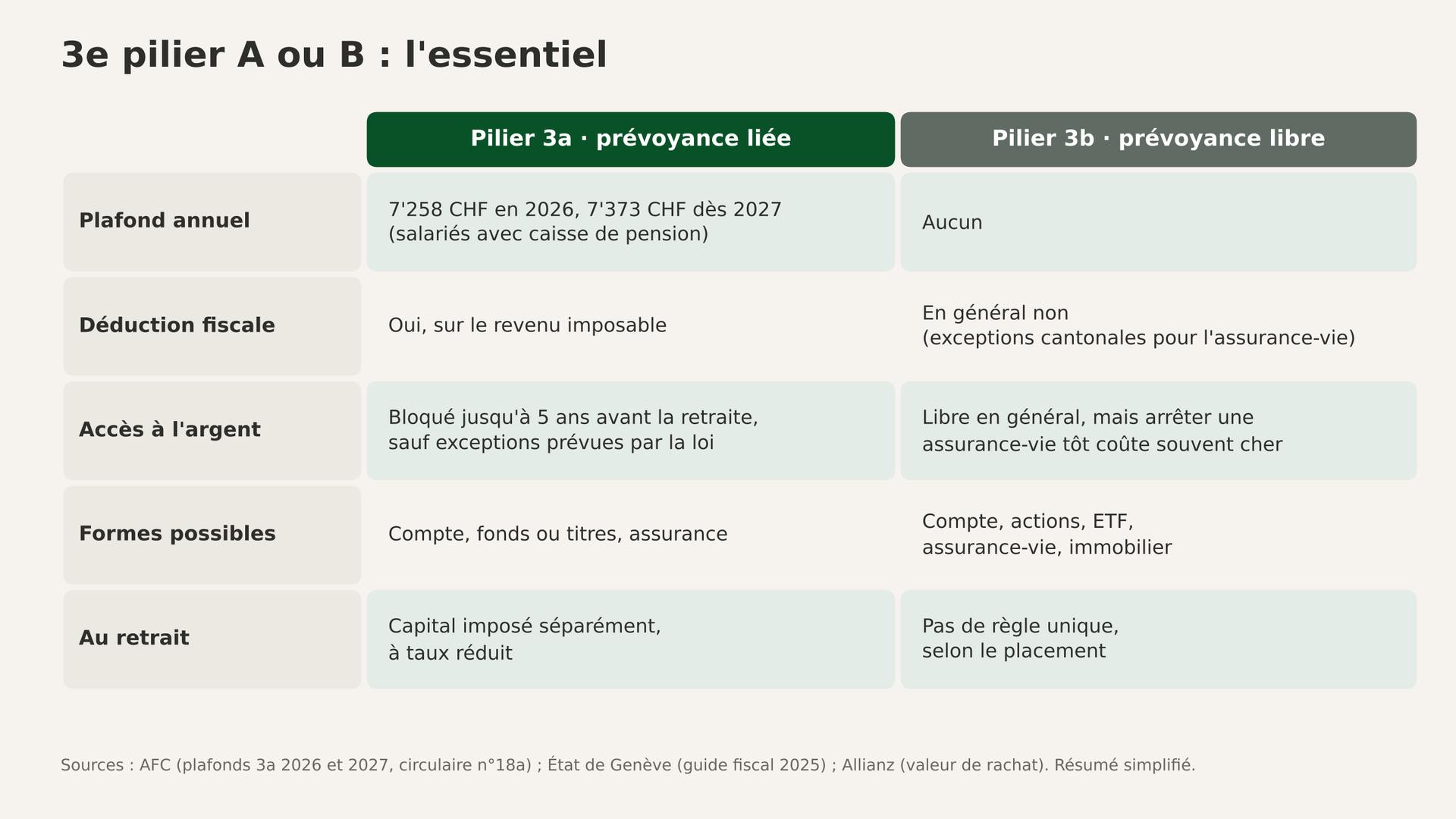
Pillar 3a is governed by law. Each year, you can pay in a capped amount: CHF 7,258 in 2026 for employees with a pension fund, then CHF 7,373 from 2027, according to the Federal Tax Administration. For self-employed people without a pension fund, the ceiling is higher.
It can be opened with a bank, as an account or in funds, or with an insurance company, in the form of life insurance. With a bank, you generally choose how much you pay in and when, up to the ceiling. With an insurer, you generally commit to regular payments set out in the contract.
The practical benefits
The first benefit is the tax deduction. Every franc you pay in can be deducted from your taxable income, in other words the income on which your tax is calculated, which reduces your tax bill.
The second benefit concerns long-term returns. With a pillar 3a account, the interest remains modest, even if it is sometimes higher than on a savings account: at PostFinance, for example, the 3a account pays 0.05%, compared with 0% on the savings account. With a pillar 3a invested in funds or securities, such as index funds like ETFs, your capital can grow more significantly over time, with some risk linked to the financial markets.
The constraints to know about
The price of these benefits is that money held in a pillar 3a is not freely available. Early withdrawal is only possible in specific situations, set out in the FAQ. When you withdraw the money, the Federal Tax Administration levies a tax on the capital, but it is generally more favourable than ordinary income tax, because it is calculated separately and at a reduced rate.
Pillar 3b: unrestricted pension provision
Pillar 3b covers all other private savings. It locks nothing away and sets no ceiling, but it generally offers few tax benefits.
How it works
Pillar 3b covers any private savings or investment that is not part of the regulated framework of pillar 3a. It can take the form of an ordinary savings account, a portfolio of shares or ETFs, life insurance, or even property.
Payments are generally not tax-deductible. A few cantons make an exception for life insurance. In Geneva, for example, premiums are partly deductible from cantonal and communal tax, according to the State of Geneva's tax guide.
Who it suits
Pillar 3b is particularly suited to three profiles:
- people who have already reached the annual pillar 3a ceiling and want to keep saving beyond it
- those who need flexible access to their money, for example for a medium-term project such as travel or renovation wor
- those who want to build up capital over the long term without the restrictions of pillar 3a, for example with a view to financial independence or early retirement.
Life insurance: in 3a or in 3b?
3rd pillar life insurance can be taken out within pillar 3a or pillar 3b. It combines savings with cover in the event of death or inability to work. In pillar 3a, its premiums follow the same rules as any 3a payment: an annual ceiling and a tax deduction.
Before you sign, be aware that ending the contract early is often expensive. The insurer Allianz itself acknowledges that the surrender value, what the insurer pays you back if you end the contract, is most often very low, or even zero, in the first years after the contract is signed.
Pillar 3a and 3b compared at a glance
Ceiling, tax, access to your money, possible forms: pillar 3a and 3b do not work on the same levers at all. The 3rd pillar comparison table below sums up the essential differences.
How to choose between the two
Whether you go for pillar 3a or 3b depends less on the products than on your situation. A few simple questions can help you see more clearly before deciding.
The questions to ask yourself
- Do I already have a reserve for unexpected expenses? If not, it comes before any locked-in payment.
- What is my time horizon? If your goal is clearly retirement, several decades away, pillar 3a is particularly relevant, and starting early makes a big difference.
- Do I need to keep my money accessible? If so, pillar 3b is more suitable, since it locks nothing away.
- What is my current tax situation? The higher your taxable income, the bigger the impact of the pillar 3a deduction on your taxes.
- What are my personal goals? Buying a home, financial independence, security for your family: each goal steers the choice between 3a and 3b differently.
The two are not necessarily exclusive
Nothing stops you from using both at the same time. Some people pay into their 3a first for the tax benefit, while others favour 3b to keep their money available. There is no obligation to pay in the maximum: even a small payment already reduces your taxable income.
Conclusion
Pillar 3a and pillar 3b follow two different logics: one favours the tax benefit and the discipline of saving, the other favours freedom and accessibility. Neither is better in absolute terms. It all depends on your situation, your goals and your time horizon.
To take a first step today, note down how much you could set aside each month without touching your reserve for unexpected expenses. That amount will already tell you what place to give 3a and 3b.
Solid retirement provision is built through small decisions, not all at once.
To get started: the Academy's Foundations programme, free, helps you lay the groundwork for your financial freedom, at your own pace.
To go further: the Academy's one-on-one support helps you address specific financial questions and structure important decisions with clarity, such as preparing for retirement.
FAQ
What is the pillar 3a ceiling in 2026?
In 2026, as in 2025, the annual pillar 3a ceiling is CHF 7,258 for employees with a pension fund. It will rise to CHF 7,373 from 2027. For self-employed people without a pension fund, it is 20% of income, up to CHF 36,288 in 2026 and CHF 36,864 in 2027.
Can you have both a pillar 3a and a pillar 3b?
Yes. You can perfectly well combine a pillar 3a for the tax benefit with a pillar 3b to keep flexibility over the rest of your savings, depending on what you need. The two complement each other more than they compete with each other.
How can you withdraw your pillar 3a before retirement?
Early withdrawal from pillar 3a is only possible in certain specific situations: buying your own home or paying off its mortgage, starting a self-employed activity, leaving Switzerland for good, buying into your pension fund, or receiving a full disability insurance pension. Outside these cases, the capital can only be withdrawn from five years before retirement age.
Is pillar 3a worthwhile for everyone?
For many people who pay tax in Switzerland, yes, thanks to the tax benefit. However, it is less of a priority as long as you do not have a reserve for unexpected expenses, since the money paid in is not freely accessible. On a low income, the tax saving is also smaller.
Which bank or insurer should you choose for your pillar 3a?
There is no single answer: it all depends on what you are looking for. A bank generally leaves you more freedom over your payments and often lets you invest in funds. An insurer adds protection in the event of death or inability to work, but commits you to regular payments and is often expensive if you stop early. In both cases, compare the fees before you sign.
⚠️ Important notice ⚠️
The information presented in this article is provided for purely informational and educational purposes. It does not in any way constitute a personalised recommendation, investment advice, an offer or a solicitation to buy or sell financial products.
Any investment decision should be made after a thorough analysis of your personal situation, your objectives and your risk profile, and may require the advice of an authorised financial adviser.
Past performance is no guarantee of future results. Investments involve risks, including the risk of capital loss.