
And it has concrete, sometimes very heavy consequences. Women's financial independence is not a luxury reserved for those who already have a lot. It is something you build, and it profoundly changes what you can do with your life.
What "financial independence" really means
When people talk about women's financial independence, they often think of earning more. The subject is actually broader, and it starts with a clear definition.
Beyond your salary and your bank account
Financial independence does not necessarily mean earning a lot or not depending on anyone financially. It is something more precise: the ability to understand your own situation and make informed financial decisions, without needing someone else to approve them or take them on for you.
It means knowing what you own, what you owe and what you are building. It means being able to answer the question "if my life changed tomorrow, where would I stand?" without the answer being vague.what
Why is it a particularly important issue for women?
In Switzerland, women live almost 4 years longer than men on average (86.3 years compared with 82.7 in 2025, according to provisional figures from the Federal Statistical Office). This is not trivial financially: a retirement that lasts longer means savings that have to last longer.
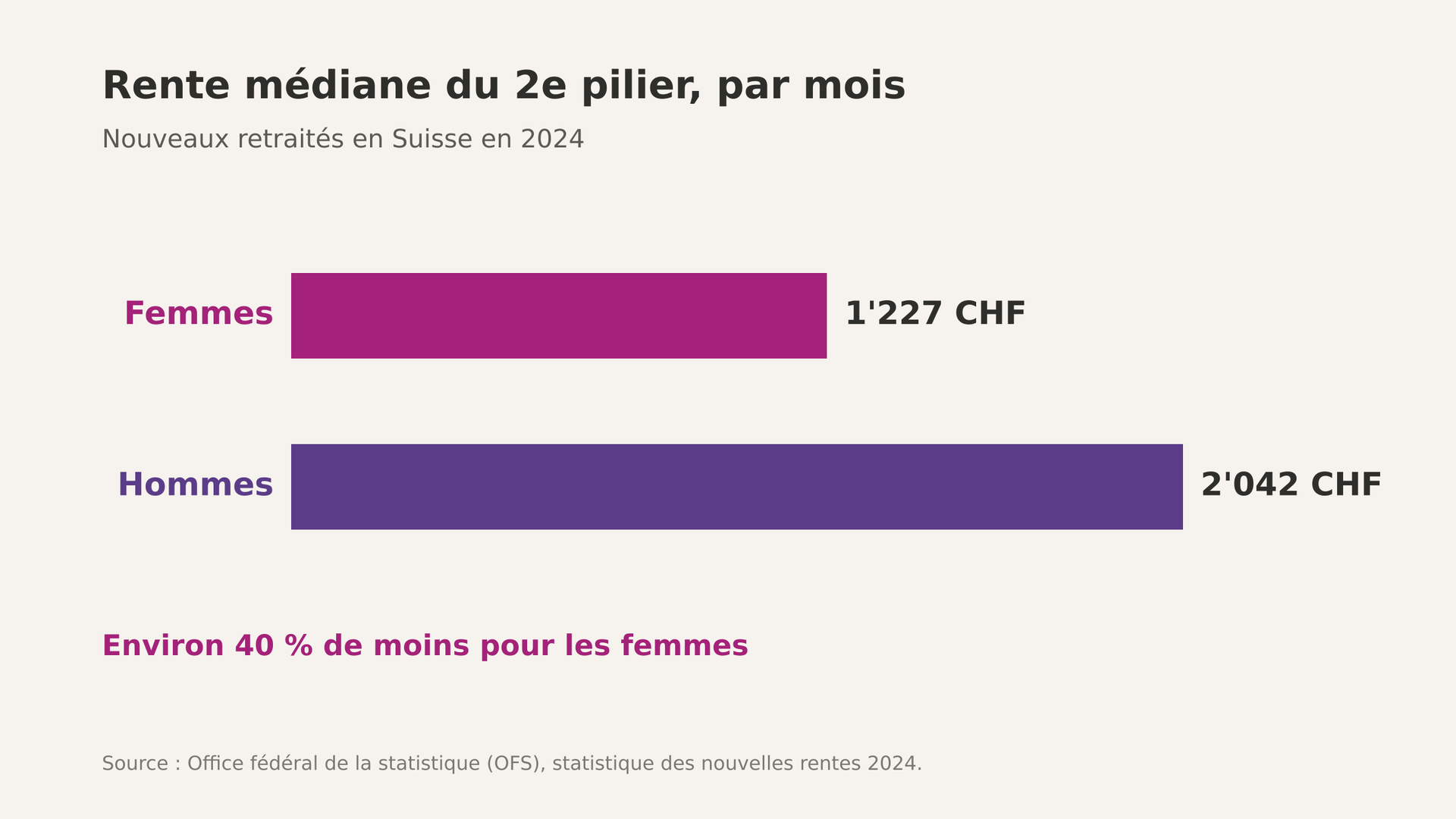
And this longer retirement often starts with fewer resources. Women who retired in 2024 receive a median pension of CHF 1,227 a month from their 2nd pillar (the occupational pension fund linked to your job, known as BVG/LPP), compared with CHF 2,042 for men who retired that year. That is about 40% less.
This pension gap does not only form at retirement: it builds up throughout working life. In Switzerland, for the same working time, the gender pay gap averages 15.7%, and 8.4% when comparing median salaries, according to federal statistics (2024). Even with a comparable profile (education, position, length of service), a gap of 6.5% remains that these differences do not explain.
On top of this comes part-time work, which concerns 58% of working women compared with 21% of men in the 2024 figures. Then there is the 2nd pillar's coordination deduction (the part of the salary that is not insured, proportionally heavier for part-time work). These two mechanisms structurally penalise women in the Swiss pension system.
The figures on women investing in Switzerland tell a similar story. A representative study by the Lucerne University of Applied Sciences and Arts (2025) finds that 43% of women invest in the stock market (shares, funds or other securities), compared with 61% of men. And the study shows that this gap does not come from being a woman, but from differences in income, wealth, financial knowledge and fear of losses.
The most common obstacles
When it comes to women and money, three obstacles come up very often. Recognising them is already a way to start moving past them.
Feeling you are not entitled
"I manage my budget well, but investing is something else."
This sentence says something important: it is not about a lack of skill. It is about a lack of permission, the permission you give yourself.
A sense of financial legitimacy is built (or not built) in childhood, through what you did or did not see around you.
It is not destiny. But it is a starting point worth recognising so you can move past it, like many other limiting beliefs about money.
The fear of making a mistake
Money touches on security, the future and years of effort. It is normal to be afraid of getting it wrong.
But this fear has an often underestimated cost: standing still. Leaving your money idle with no strategy, avoiding questions for fear of looking ignorant, putting off important decisions... all of this has real financial consequences, even if they are silent, like most common financial mistakes.
A mistake can be corrected. Lost time cannot.
Delegating by default
Entrusting the management of your assets to your partner or an adviser is not a problem in itself.
It can become one if you do not understand what is happening, if you sign without knowing.
Because situations change. A divorce, a death, a separation that is amicable but financially chaotic: these moments happen. And discovering your own financial situation in the middle of the pain is one of the most destabilising experiences a woman can go through.
Delegating while understanding is possible. Delegating by stepping aside is a risk.
Building your financial independence
Financial independence does not happen overnight. It is built step by step: looking at your situation, learning, then making decisions with full knowledge of the facts.
Start by facing your situation
Before optimising, investing or planning anything, there is one step nobody can skip: knowing where you stand.
In practice, many women have never honestly taken stock. Not because they do not care, but because nobody showed them how, and the exercise can be frightening.
Three steps are enough to start.
- List your accounts and savings, with the amount in each
- Find your 2nd pillar certificate and your pillar 3a statement (your private pension savings)
- Write down your debts and your fixed monthly costs
One hour is often enough. It is not an exam, it is a snapshot of your situation at a given moment.
Learn at your own pace, without judgement
The truth is that personal financial management is not a discipline reserved for experts. It is a skill. It can be learned gradually, with the right reference points, without needing to master everything from the start. Starting with a single concept, such as reading your 2nd pillar certificate, is often enough to make the fear go away.
Making informed decisions
The aim is not to become an expert.
It is to be able to look at your financial situation without avoiding it, to ask questions without feeling illegitimate, and to understand what you sign and what you invest in.
That is what financial autonomy is. Not perfection: clarity.
Financial independence as an act of sovereignty
Having control over your finances means having control over your choices. Staying in a relationship or leaving it. Changing career without financial fear being the only factor. Supporting someone, funding a project, saying no to what does not suit you.
Money is not an end in itself. But it is the concrete basis of a very real freedom.
Conclusion
Every woman has the ability to understand and take control of her finances.
Not because it is easy. Not because the path is the same for everyone. But because this skill can be learned, and because it opens up choices you did not have before.
To take a first step today, write three figures on a sheet of paper: what comes in each month, what goes out, and what you have put aside. That is the start of your stock-take.
And clarity always begins with deciding that you deserve it.
To get started: the AdvisorOne Diagnostic helps you take stock of your situation, with no commitment and no jargon.
To go further: the monthly "Become the CEO of your finances" workshop from WomenInvest lets you make progress in a small group, with no commitment and no prior knowledge required.
FAQ
Where do you start when you know nothing about finance?
With your own situation. Before any advice, strategy or tool, you need to know what you earn, what you spend and what you own. This first stock-take, honest and without judgement, is always the starting point. If the figures worry you, do it with someone you trust: an outside view helps you keep a cool head.
How do you take back control of your finances after a separation?
By starting with an inventory of what exists: accounts, savings, contracts and debts, without forgetting the 2nd pillar and pillar 3a, which are often overlooked at such times. The first few weeks often reveal a situation that is more complex (or simpler) than expected. Professional support can help you see clearly, quickly.
Do women invest differently from men?
Less than people think. A study published in 2025 in the Review of Financial Studies shows that among single people, women invest less mainly because lower incomes and more dependants make them more vulnerable to unexpected events, not because of a different taste for risk. A safety reserve therefore helps you invest with more peace of mind.
How can you talk about money as a couple without it turning into a conflict?
By separating facts from emotions. When talking about money as a couple, start with your own financial situation (what you know, what you do not know, what you would like to understand) before discussing joint decisions. Being open about your own gaps often defuses more tension than it creates.
Is it possible to build financial independence on a modest income?
Yes. Financial independence is not an income threshold, it is a way of positioning yourself in relation to your money. Understanding your situation, making conscious choices, saving even modestly: in your personal finances, these habits have a real impact, whatever your starting point.
⚠️ Important notice ⚠️
The information presented in this article is provided for purely informational and educational purposes. It does not in any way constitute a personalised recommendation, investment advice, an offer or a solicitation to buy or sell financial products.
Any investment decision should be made after a thorough analysis of your personal situation, your objectives and your risk profile, and may require the advice of an authorised financial adviser.
Past performance is no guarantee of future results. Investments involve risks, including the risk of capital loss.