
Yet this money is meant for retirement, and the law only releases it in a few specific cases. Here are the conditions for withdrawing your 2nd pillar early, and what is worth knowing before you go ahead.
Why your 2nd pillar stays blocked until retirement
The 2nd pillar is first and foremost there to fund your retirement. That is why the money stays in your pension fund until then, in principle, except in the situations provided for by law.
Money set aside for your retirement
Every month, part of your salary goes into your pension fund, topped up by your employer. Together with the AHV/AVS (old-age and survivors' insurance), these savings should allow you to maintain a good part of your standard of living once you retire.
It is to protect this goal that a 2nd pillar withdrawal is tightly regulated. You cannot dip into it like a savings account. In the meantime, the money earns interest: for the minimum part required by law, the minimum interest rate is 1.25% in 2026.
Three main cases before retirement
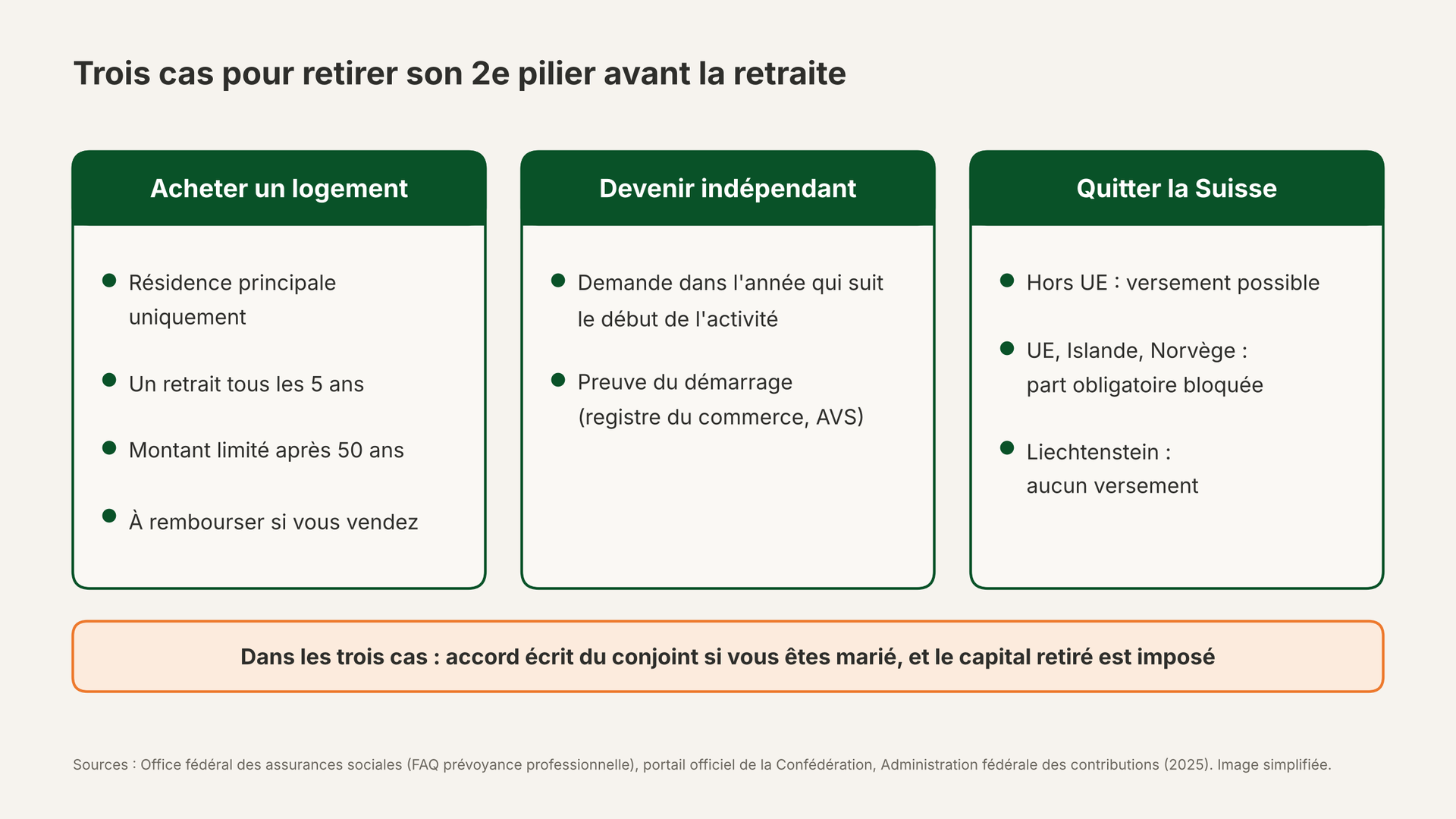
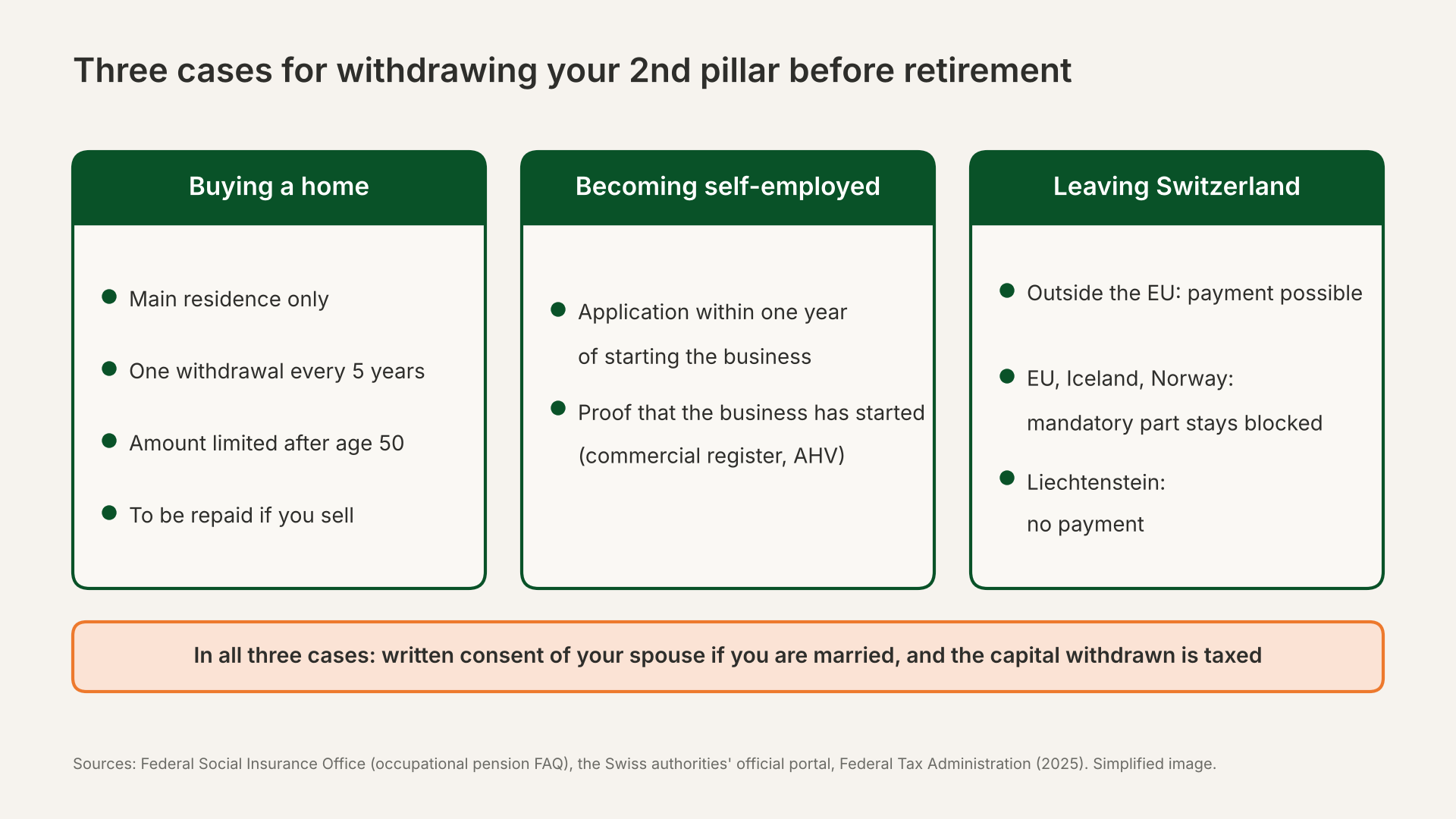
An early withdrawal, meaning before retirement, is possible in three main situations: buying a home to live in, starting a self-employed activity or leaving Switzerland for good.
Outside these cases, the money stays in your pension fund. For example, it is not possible to withdraw your 2nd pillar to repay debts. In all three cases, if you are married, you also need your spouse's written consent.
Your pension fund checks the conditions and pays out the money. So contact it first, before you sign anything.
Withdrawing your 2nd pillar to buy a home
Buying a home is one of the reasons that allow an early withdrawal. But the home must be yours, the one you live in, and several rules apply before, during and after the purchase.
For your main residence only
The money can only be used for the home you live in yourself, your main residence. You can use it to buy it, to repay part of your mortgage, meaning the bank loan, or to buy shares in a housing cooperative.
It can be a flat or a house, as long as you live there yourself. A second home or a holiday home is excluded, as the Federal Social Insurance Office points out.
The rules to follow
For a home, a 2nd pillar withdrawal follows four main rules.
- A withdrawal is only possible every five years
- Up to age 50, you can withdraw all your savings; after that, the amount is limited
- If you are married or in a registered partnership, your spouse or partner must give their consent
- If you sell the home, you must pay the sum back to your pension fund
What the withdrawal changes for you
Your retirement pension is calculated from the savings you have built up. Withdrawing money for a home therefore reduces your savings, and the pension you will receive later. Your pension fund can tell you by how much.
Take a hypothetical example. Inès withdraws CHF 60,000 to buy a home. With the 6.8% conversion rate set by law for the minimum part, meaning the percentage that turns capital into a pension, this represents about CHF 4,080 less pension a year, or CHF 340 a month. And that is without counting the interest this sum would have earned until retirement.
The withdrawal is also taxed, separately from your other income and at a reduced rate, as the Federal Tax Administration explains. And if you have made a buy-in to your 2nd pillar in the previous three years, the withdrawal can make you lose the tax deduction you received.
Withdrawing your 2nd pillar to become self-employed
Setting up on your own can take money to get started. The law then allows you, under certain conditions, to withdraw your 2nd pillar to become self-employed, since you leave the compulsory system for employees.
Why it is possible
The compulsory 2nd pillar applies to employees. When you become self-employed, you are therefore no longer compulsorily insured, and you can ask for your savings to be paid out.
The conditions to meet
To receive this payment, three conditions must be met.
- Apply within one year of starting your activity
- Prove that it has started, for example with an entry in the commercial register or an AHV certificate
- Obtain your spouse's written consent if you are married
A decision to weigh carefully
Without a 2nd pillar, your retirement rests on the AHV and on what you save yourself. If the business does not work out as planned, the money invested in it can be lost, and your retirement savings along with it.
On the other hand, a self-employed person without a pension fund can pay more into a pillar 3a: up to 20% of their earned income, with a maximum of CHF 36,288 in 2026. The withdrawal itself is taxed in the same way as for a home. And it is not an obligation, because a self-employed person can also choose to join a 2nd pillar voluntarily.
Withdrawing your 2nd pillar when leaving Switzerland
Moving abroad for good is the third situation provided for. In principle, withdrawing your 2nd pillar when leaving Switzerland is possible, but what you can take with you depends on the country you choose.
Moving outside the European Union
If you leave Switzerland for good to settle abroad, outside the European Union, you can in principle ask for your 2nd pillar to be paid out. In the United Kingdom, for example, the full amount can be paid out since 1 November 2021.
Moving within the European Union
For the European Union, Iceland or Norway, the rule changes. The mandatory part, meaning the minimum required by law, cannot be withdrawn if you are compulsorily insured in your new country. It stays in Switzerland in a blocked account until retirement.
The extra-mandatory part, what your pension fund saves on top of the minimum, can however be paid out. And for Liechtenstein, no payment is possible.
Before you leave
Ask your pension fund which part of your savings is mandatory and which is not. This changes what you can take with you. The part that stays blocked does not disappear: it waits for you until retirement.
Bear in mind too that the capital paid out is taxed. The simplest approach is to contact your pension fund a few months before you leave, to prepare the documents.
Before you withdraw: questions to ask yourself
A 2nd pillar withdrawal reduces your retirement for a long time. Before you apply, a few simple questions help you check that the plan holds up.
- Will my reserve for unexpected expenses stay intact once the project is under way?
- Have I asked my pension fund how much I can withdraw and how it will affect my pension?
- Have I estimated the tax on the withdrawal with my tax authority?
- Have I made a buy-in to my 2nd pillar in the last three years?
- Does my spouse agree, and have we made the decision together?
If any of these answers is still unclear, take the time to clarify it. A few weeks of thought count for little against twenty or thirty years of retirement.
Conclusion
The 2nd pillar is meant for your retirement. The law allows you to withdraw it earlier in three cases: buying your main residence, starting a self-employed activity and leaving Switzerland for good.
Each case has its conditions, and a withdrawal always comes at a price: less savings for retirement, tax to pay, and sometimes a part that stays blocked. It therefore deserves to be prepared, not decided in a hurry.
To take a first step today, find your latest pension certificate and write down the amount of your retirement savings. That way, you will know what you are talking about with your pension fund.
A well-prepared project also protects your retirement.
To get started: the Academy's Foundations programme, free, helps you lay the groundwork for your finances at your own pace.
To go further: the Academy's one-on-one support helps you structure your financial decisions, such as preparing for retirement.
FAQ
Can you withdraw your 2nd pillar to repay debts?
No. The law provides no way of withdrawing your 2nd pillar to pay debts, even large ones. If your debts are becoming hard to manage, debt counselling services exist in every canton and can help you get back to a manageable budget.
Is a 2nd pillar withdrawal taxed?
Yes. The capital withdrawn is taxed separately from your other income, at a reduced rate for federal tax. The rules and rates then vary from one canton to another. The amount of tax therefore depends on where you live and on the sum withdrawn, which is worth checking before any decision.
Do you need your spouse's consent to withdraw your 2nd pillar?
Yes, if you are married. Whether it is for a home, to become self-employed or to leave Switzerland, your pension fund will ask for your spouse's written consent. For a home or a self-employed activity, the same rule applies to a registered partner.
How do you find a forgotten 2nd pillar before applying for a withdrawal?
Contact the Central Office 2nd Pillar, which gives free information on forgotten savings. If you did not reply to a transfer form when you left a job, your money may have been handed over to the Substitute Occupational Benefit Institution, a foundation that looks after savings without instructions.
⚠️ Important notice ⚠️
The information presented in this article is provided for purely informational and educational purposes. It does not in any way constitute a personalised recommendation, investment advice, an offer or a solicitation to buy or sell financial products.
Any investment decision should be made after a thorough analysis of your personal situation, your objectives and your risk profile, and may require the advice of an authorised financial adviser.
Past performance is no guarantee of future results. Investments involve risks, including the risk of capital loss.