
It also has its rules and constraints, which are worth knowing before you pay in a single franc.
What is a buy-in to the 2nd pillar?
A buy-in is money you pay into your pension fund of your own accord, on top of the contributions deducted from your salary every month. It is used to make up for a shortfall in your retirement savings.
Filling a pension gap
Your 2nd pillar (occupational pension, known as BVG/LPP) fills up year after year, with your salary. When some years are missing or bring in less, your savings fall behind: this is known as a pension gap.
This shortfall can have several causes: starting your career late, a period of part-time work, a career break or a pay rise. In the last case, your pension fund plans a higher pension, but the savings from past years have not kept up. A buy-in lets you make up part of this gap, and so improve your future retirement.
How much can you buy in?
You cannot pay in as much as you like. The maximum depends on what your pension fund's regulations provide for, as set by the occupational pensions act.
Your pension fund calculates this amount, known as your buy-in potential. It sometimes appears on your pension certificate. It takes into account your age, your salary and the savings you have already built up. Before making any plans, ask your fund for an up-to-date statement.
There are a few special cases. If you have already withdrawn money from your 2nd pillar to buy a home, you must first pay it back before you can buy in. If you arrive in Switzerland without ever having been insured with a pension fund, special rules apply. Buy-ins linked to a divorce, on the other hand, are not subject to these limits.
Self-employed people with a pension fund
The self-employed do not have to have a 2nd pillar, but they can set one up. If their fund's regulations allow it, they can then buy in all the contributions they could have paid from the earliest possible age, as the Federal Supreme Court has confirmed. For self-employed people who start late, the buy-in potential can therefore be high.
The tax deduction for a buy-in
This is the advantage that gets buy-ins talked about. It is real, but its effect depends on your income, your canton and when you make the buy-in.
An amount deducted from your taxable income
In principle, a 2nd pillar buy-in is deducted from your income, for federal tax as well as for cantonal tax, as the Geneva tax authority points out. Your taxable income, meaning the income on which your taxes are calculated, is therefore reduced by the amount paid in.
How much will you save? That depends on your marginal tax rate, meaning the tax rate that applies to the last francs you earn. The higher this rate, the more the tax deduction cuts your bill.
A worked example
Take a buy-in of CHF 10,000 and a hypothetical marginal tax rate of 25%. Your taxes would fall by about CHF 2,500. The buy-in would therefore cost you about CHF 7,500, for CHF 10,000 added to your retirement savings. And this CHF 10,000 stays blocked until retirement.
This rate is only an example. Depending on your canton, your municipality, your income and your family situation, the real saving can be much lower or higher. Your tax authority or an official tax calculator will give you a more accurate estimate.
Spreading buy-ins over several years
Income tax is progressive: the more you earn, the higher the rate. With one large buy-in in a single year, part of the deduction falls into less heavily taxed brackets, and therefore saves you less.
Spreading a buy-in over several years can therefore, in some cases, increase the total saving. Watch out, however, for the three-year rule, explained just below.
The rules to know before buying in
A buy-in ties up your money for a long time. Three points deserve your attention before you decide, especially if you have plans for the next few years.
The three-year rule
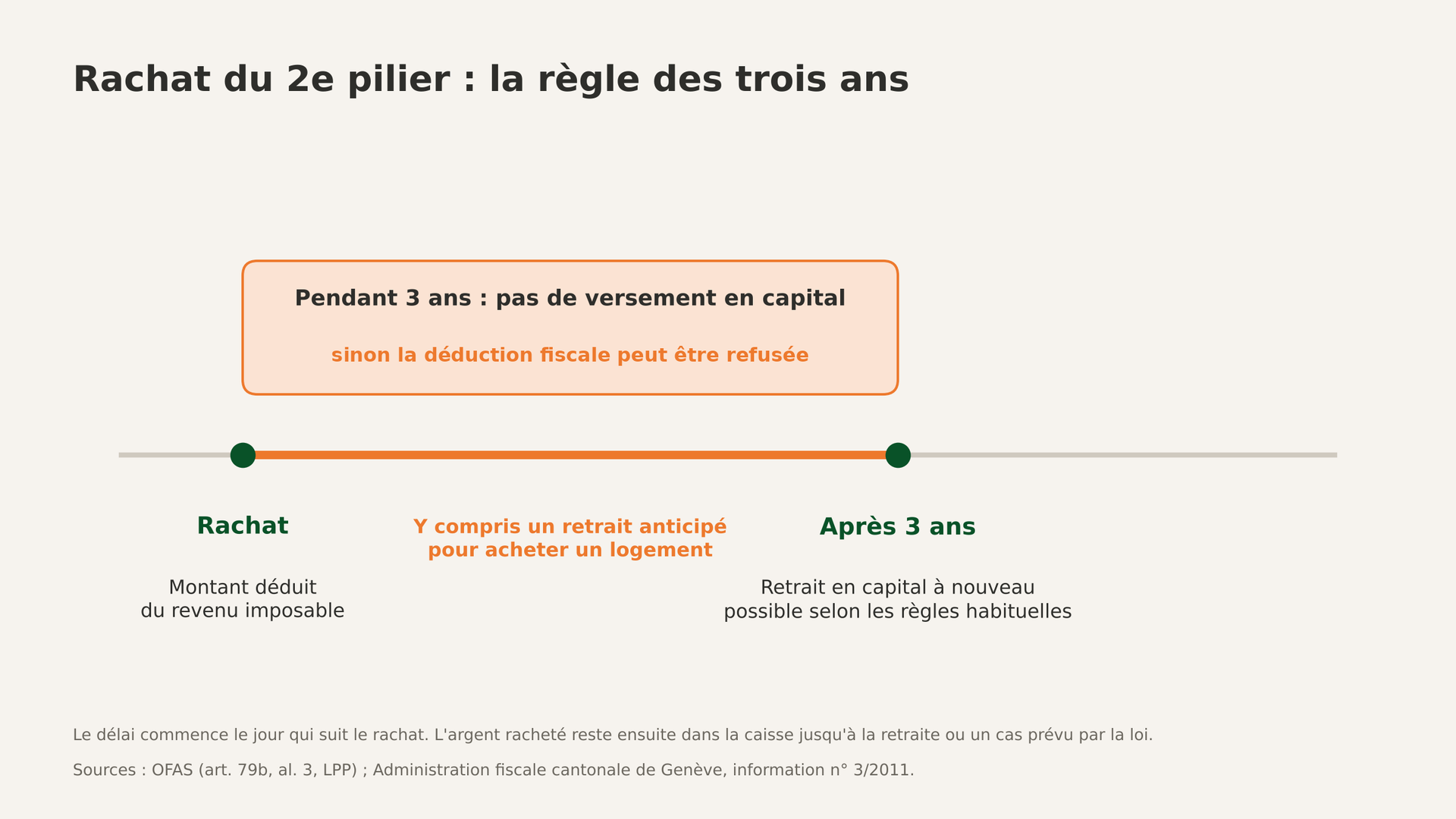
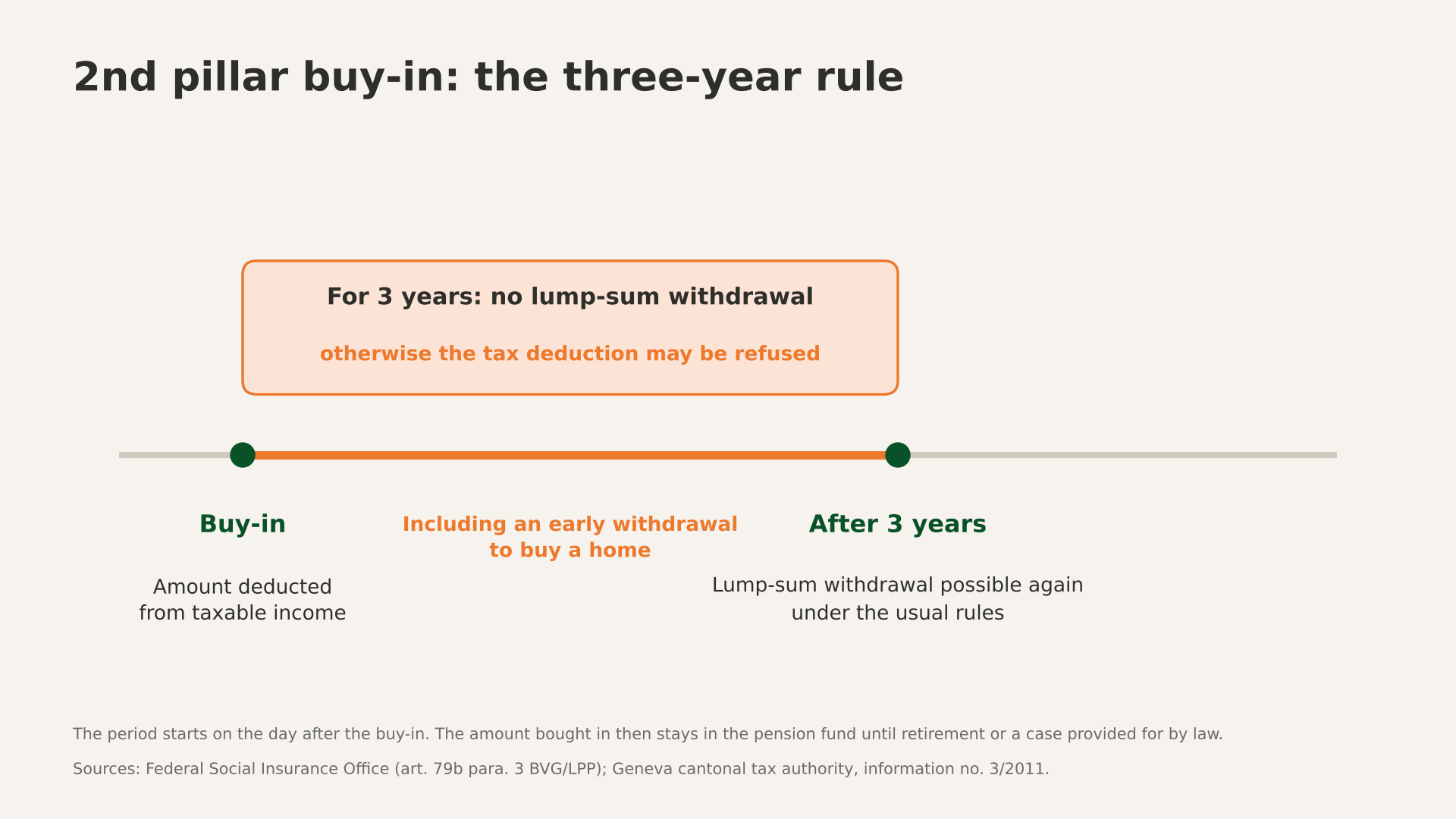
After a buy-in, the law prohibits you from withdrawing this money as a lump sum, meaning all at once, for three years. If a lump sum is paid out anyway, the tax authority may refuse the deduction. In Geneva, for example, it refuses it systematically, whatever the reason.
This also applies to a withdrawal to buy your home. The three years start on the day after the buy-in. In Geneva, if you have several pension funds, they are even assessed together. If you plan to buy your main home soon, a buy-in can therefore make you lose the tax advantage.
Money blocked until retirement
Once paid in, the money becomes part of your 2nd pillar. You will only be able to get it back at retirement, or in a few cases provided for by law, such as buying a home, starting a self-employed activity or leaving Switzerland for good.
That is why a buy-in should never come at the expense of your reserve for unexpected expenses. This money will not be able to help you if things go wrong.
In the meantime, it earns interest, set by your pension fund.
2nd pillar buy-in or a payment into pillar 3a?
Both reduce your taxes, but they do not work in the same way. Pillar 3a has an annual limit: CHF 7,258 in 2026 for an employee with a pension fund. A buy-in, on the other hand, depends on your buy-in potential.
Some people start with pillar 3a, which is more flexible, then consider a buy-in. Since 2025, it has also been possible, under certain conditions, to make up for missed years of 3a contributions. Pillar 3b remains more flexible but is generally not tax-deductible.
Who might a buy-in suit?
There is no single answer. A buy-in suits some situations better than others, and a few simple questions can help you see more clearly.
A buy-in can make sense if your retirement savings have fallen behind, if your taxable income is fairly high, if you have money available on top of your reserve and if you will not need it before retirement. It makes less sense if you have consumer debt or a property purchase coming up soon.
Before you decide, ask yourself these questions.
- Is my reserve for unexpected expenses in place, and is my consumer debt paid off?
- Will I need this money in the next three years, for example to buy a home?
- What is my buy-in potential, according to a recent statement from my pension fund?
- How much tax can I really expect to save, given my canton and my income?
If everything is in order, the process is simple. Ask your pension fund for the statement, check that no lump-sum withdrawal is planned within three years, make the payment, then enter the buy-in in your tax return with the confirmation from your fund.
Conclusion
A 2nd pillar buy-in lets you fill a pension gap while reducing your taxes. But this money stays blocked until retirement, with some exceptions, and a lump-sum withdrawal within three years can cancel out the tax advantage.
Remember three ideas. The amount you can buy in depends on your pension fund. The tax saving depends on your marginal tax rate. And a buy-in comes after your reserve for unexpected expenses, never before.
To take a first step today, look on your pension certificate to see whether a buy-in amount is shown, or ask your pension fund for it.
With the right information, a buy-in becomes a considered choice rather than a tax reflex.
To get started: the Academy's Foundations programme, free, helps you lay the groundwork for your finances at your own pace.
To go further: the Academy's one-on-one support helps you structure your financial decisions, such as preparing for retirement.
FAQ
How much can you buy into your 2nd pillar?
It depends on your pension fund. The maximum follows from its regulations and takes into account your age, your salary and the savings you have already built up. Your pension fund can give you a statement showing this amount. Ask for it before making any payment, and keep it with your tax documents.
Is a 2nd pillar buy-in always tax-deductible?
In principle yes, for federal tax as well as for cantonal tax. It is not guaranteed in every case, however: if a lump sum is withdrawn within three years of the buy-in, even to buy a home, the deduction may be refused. And the real saving depends on your marginal tax rate.
Can you withdraw your 2nd pillar after a buy-in?
Not as a lump sum during the three years following the buy-in. After that, the usual rules apply: withdrawal at retirement, or earlier in the cases provided for by law, such as buying a home. If a plan of this kind is coming up, it is better to take it into account before buying in, so as not to lose the tax advantage.
Is it better to buy into your 2nd pillar or pay into your pillar 3a?
There is no universal answer. Pillar 3a is capped every year but more flexible, while a buy-in depends on your potential and blocks the money in your pension fund until retirement. Some people start with pillar 3a. The right choice depends on your income, your plans and how much money you want to keep available.
⚠️ Important notice ⚠️
The information presented in this article is provided for purely informational and educational purposes. It does not in any way constitute a personalised recommendation, investment advice, an offer or a solicitation to buy or sell financial products.
Any investment decision should be made after a thorough analysis of your personal situation, your objectives and your risk profile, and may require the advice of an authorised financial adviser.
Past performance is no guarantee of future results. Investments involve risks, including the risk of capital loss.